


The Seven Types of Business Story
YOUR COMPANY OUTGREW ITS STORY:
THAT'S WHAT'S SLOWING EVERYTHING DOWN.
You're in a board prep. The deck's been rewritten twice. Your VP of Sales explains the company one way. Product explains it another. The investor across the table asks, "So what exactly do you do?" — and you know the answer you give won't survive the retelling.
This isn't a messaging problem. It's a structural one. The story that raised your Series A can't carry the weight of what comes next — the hire, the close, the raise.
When messaging fragments, everything downstream breaks: sales cycles stretch, onboarding stalls, and you become the bottleneck for every conversation that matters.
We fix the layer underneath the deck. In 4–6 weeks, we harden your story into a set of shared constraints your team, your investors, and your sales motion can operate from — without you translating every time.
Focus on scaling. We'll get the story straight.
YOUR COMPANY ALREADY HAS A STORY. THE QUESTION IS WHETHER IT'S WORKING.
You don't need to be a storyteller. You need to know which story your company is actually living — and whether it's working for you or against you. Your story type reveals the pattern underneath your messaging: why some conversations land and others stall, why certain pitches close and others drift. Name the pattern, and the right language follows.
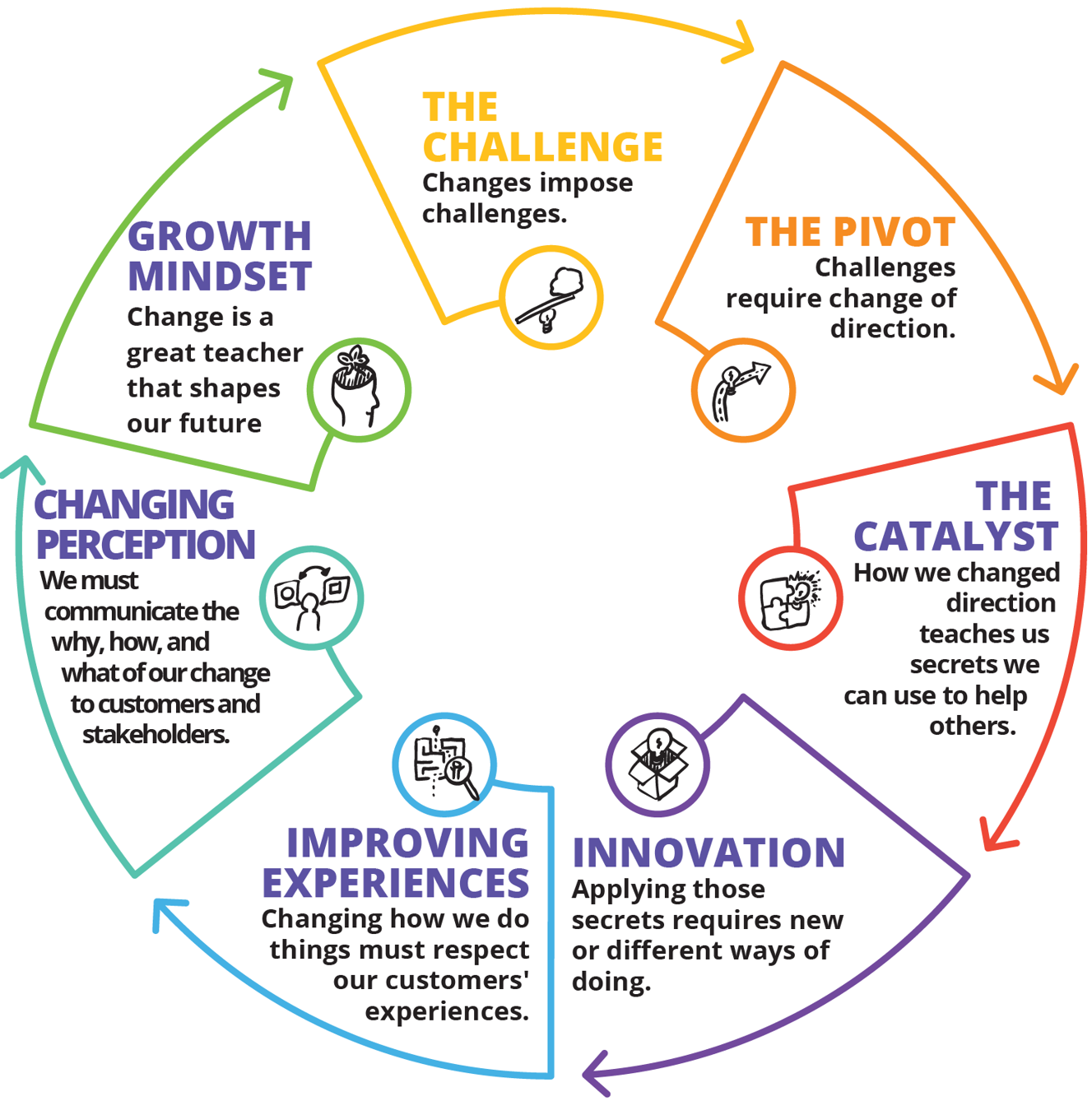
The Challenge focuses on resilience and adaptability, inspiring others to overcome adversity.
The Pivot is about strategic shifts, demonstrating your company's agility and customer-centric approach.
The Catalyst emphasizes your role in accelerating change and solving problems, positioning you as a trusted partner.
Innovation showcases your commitment to pushing boundaries and creating groundbreaking solutions.
Improving Experiences underlines your dedication to customer satisfaction and building lasting relationships.
Changing Perceptions is about shifting how your customers and stakeholders think about you.
The Growth Mindset encapsulates your commitment to growth and its value to customers.
Overview of the types below.
For a deeper dive and how to apply them, jump over to this article.
The Seven Types of Business Story
The Challenge
Something broke the plan. A market shift, a failed launch, a competitor you didn't see coming. You're in the middle of it — not past it, not above it, in it.
This is where your story gets forged. Not in the vision deck. Not in the mission statement. In the response. How you talk about what went wrong — and what you're doing about it — tells people more about who you are than anything you say when things are going well.
The trap here is spin. The instinct is to frame the difficulty as a blessing in disguise. Don't. The companies and leaders who earn trust in this state are the ones who name the problem plainly and show the work. That's the story worth telling.
The Pivot
You changed direction. Not because you failed — because you saw something the old plan couldn't reach. A market signal, a customer need, a better path that only became visible once you started moving.
This is the hardest story to tell well. Most people either over-explain the pivot (defensive) or skip it entirely (hoping nobody notices). Both cost you credibility. The pivot story works when it's simple: here's what we believed, here's what we learned, here's what we're doing now.
The risk in this state is narrative whiplash — your team, your customers, and your investors are all holding a different version of "what happened." If you don't name the shift clearly, everyone fills in their own.
The Catalyst
You accelerate change around you. Not by selling harder — by seeing what others miss and making it obvious. You walk into a stalled conversation and something moves.
This state shows up when your value isn't the product or the service — it's what happens when you enter the room. The story here isn't about what you built. It's about the before and after you create for others.
The danger: this becomes a hero story fast. "We fixed everything" is less convincing than "here's the pattern we spotted and how it changed the outcome." Show the mechanism, not the cape.
Innovation
You built something new. Not a feature — a different way of solving the problem. Something that requires people to think differently before they can buy, adopt, or believe.
This is a high-risk story state because novelty creates confusion as often as it creates interest. The more original your solution, the harder it is to explain. And if people can't explain it, they can't buy it, fund it, or champion it internally.
The work in this state isn't inventing better — it's translating what you've already invented into language that doesn't require a whiteboard. If your story needs 20 minutes and a diagram, you haven't found it yet.
Improving Experiences
You're not reinventing the wheel. You're making it roll smoother. The value you create isn't dramatic — it's felt. Fewer friction points. Better outcomes. A process that used to hurt and now doesn't.
This story state is deceptively hard to communicate because the change looks small from the outside. "We made it better" isn't a headline. But "here's what used to take three weeks and now takes three hours" — that's a story people repeat.
The trap here is modesty. Companies and leaders in this state tend to undersell because the improvement feels obvious to them. It's not obvious to everyone else. Name the gap between how it was and how it is now. That gap is your story.
Changing Perceptions
The world thinks you're one thing. You're becoming something else. Maybe you outgrew your category. Maybe your reputation hasn't caught up to your reality. Maybe the market still sees last year's version of you.
This is a trust story. You don't win it by announcing the change — you win it by proving it's already happened. The gap between what people believe about you and what's actually true is either a problem or an opportunity. It depends entirely on whether you can show the evidence.
The mistake most make here: leading with aspiration instead of proof. "We're now a platform" means nothing. "Here's what three customers did last quarter that was impossible a year ago" — that rewires perception.
Growth Mindset
You're not just scaling — you're learning in public. Setbacks aren't buried. Mistakes get examined. The culture treats friction as data, not failure.
This story state works because it signals something rare: the willingness to be wrong and adjust. In a landscape full of companies performing confidence, admitting what you don't know yet — and showing how you close the gap — earns disproportionate trust.
The risk is that this becomes a brand exercise instead of an operating truth. "We value learning" on a wall means nothing. "Here's what we got wrong last quarter and the three things we changed" — that's a growth story people believe.
Which one are you living?
You probably recognized your company in one of the seven. The next question isn’t which type — it’s whether that story holds when you’re not in the room. The Narrative Drift Assessment takes three minutes: fifteen questions, a score, and a named diagnosis of where it slips.