

The Seven Types of Business Story

Tell a Powerful Story That Will Get Audience's Attention and Drive Action
Facts, opinions, and value statements push people apart, stories bring people together. – Chuck Matthei
Storytelling is the calculated release of information. – Alex Garland
Imagine standing before your audience, delivering a message that's perfectly aligned with your story type—this is communication stripped down to its most powerful essence, without fluff or theatrics. Communication that makes a connection. It's like this for some of the best stories told. The audience doesn't just listen; they engage on a deeper level. It's a good story, and they know it.
Why does this happen? It's because your words have helped to release oxytocin and serotonin in their brains, chemicals that foster bonding and trust. This isn't a marketing strategy; it's rooted in the principles of neuroscience.
Here's the key insight: Mastery of narrative arcs or the art of traditional storytelling isn't necessary to make an impact.
What's important is to identify and learn how to tell a story that encapsulates your core business story type. This approach isn't about spinning yarns or using fancy words; it's about ensuring your messaging resonates naturally with your audience—whether they are customers, team members, or partners. These types of stories help forge neuroscientific connections that lead to deeper engagement. What more could you ask for? Discover yours here (opens in new window).

In the early 1980s, my life took a pivotal turn when my father's job at Intel led us to America, transforming an intended 18-month stay into nine transformative years. This period granted us precious memories captured through my father's Olympus SLR and shaped my diverse interests and resilience. Diagnosed with ADHD at five and dyslexia at eighteen, I learned early the importance of perseverance. Even as a child, whether facing the daunting obstacle of moving every year or so or navigating the complexities of my conditions - of which ADHD was unfortunately left to languish, it wasn't until my 40s that I was officially rediagnosed and finally started to tackle it. I embraced each obstacle with a determination instilled by my hardworking parents, and this foundational period of my life laid the groundwork for the journey ahead, a relentless quest for questioning the status quo. It led me to shun Hollywood and The Hero's Journey for business storytelling and to discover the 7 Types of Business Stories.
Do you read stories? Watch movies? And wish you could be as compelling and interesting?
Seven types of business stories can catalyze this connection—The Challenge, The Pivot, The Catalyst, Improving Experiences, Changing Perceptions, and Growth Mindset. These themes and blueprints help people connect and interact with your brand on a meaningful level. Let's explore these story types in depth and determine which will best help your company connect with its audience today. Kudos to you for making the effort and time to start this journey.
I'll try my best to show you how stories help. Remember, while it can take hard work to become a master storyteller, when you follow what I share in this blog, you will benefit from an understanding and a rapid start to better business storytelling.
⬇️ Jump to the 7 Types ⬇️
Why is storytelling so important?
That’s what storytellers do. We restore order with imagination. We instill hope again and again. - Walt Disney.
We all like listening to stories. Storytelling is an intrinsic part of being human, rooted in the depths of time and bridging the individual and the collective consciousness. It's not merely a means of entertainment; it's a profound way in which we navigate and make sense of the world. Through storytelling, we engage, motivate, and inspire, creating emotional connections that transcend mere data or facts. Through the stories we share, we understand ourselves and others better, finding commonality and shared meaning in any situation.
Our proclivity for stories stems from their centrality to human cognition and communication. They are more than a recitation of events or an idea; they are reflections in which we see ourselves, our values, and our journeys, allowing us to interpret our lives and the world around us.

The importance of this cognitive process cannot be understated. It helps us comprehend complex concepts, empathize with different perspectives, and learn based on the successes and failures of others. Stories told in this way get attention and take people on a journey. And when you share stories, it is because they play to these facts. Make this year the year you do the same.
Contrary to the notion that storytelling is an offshoot of entertainment, it is, in fact, the other way around. When you think about it, the pleasure we derive from a well-told story, be it by a friend or in a movie or a book, it is a byproduct of storytelling's ability to effectively communicate what we go through and solicit the necessary support to navigate our lives successfully. Entertainment media such as literature, film, and art have their roots in the fundamental human need to tell stories. To transmit information with feeling.
By acknowledging storytelling's essential role in shaping and understanding our perceptions and emotional state, we can harness its power to influence, teach, and forge deeper connections in places where we used to scratch the surface. In essence, stories are the fabric of our existence, woven into the very way we perceive, interact with, and understand the world and each other. Remember, they are fundamental, not ancillary, to human culture and interaction.
Why storytelling is important in business
Stories constitute the single most powerful weapon in a leader’s arsenal. --Dr. Howard Gardner, professor Harvard University
In a word, authority. At work, storytelling emerges as an indispensable tool to help organizations share their vision and ethos. And, importantly, deliver information in an easy, palatable manner. It goes beyond mere transactional interactions to create a world where customers feel a part of the narrative. Great companies understand that to engage and resonate with people, they need to tell a story that weaves together character, emotion, and a journey that reflects not just their brand, but also the lives of their audience. When a brand shares stories, they offer more than products or services; they provide an experience steeped in emotional resonance. They provide a reason to care. By listening to stories, customers learn about the company's core values and the passion behind their offerings, fostering a sense of loyalty and connection. A narrative isn't just a marketing tactic; it's a strategic way to build a robust community with feeling around a brand, making it an essential skill in today's market. And it empowers companies to communicate the depth of their character in a way customers know and will like. Are you ready to give it a try?
What is the power of business storytelling?
The story-making process enables us to simplify complex information into the core essence of understanding.
– Yiannis Gabriel, Storytelling in Organizations
Stories in this context are impactful because they get attention and impart information in a way that is easy to understand and remember. You know this because it is just like your favorite movie or book. They can make sense of complex data and abstract ideas, transforming them into something relatable and human. The importance of storytelling in commerce lies in its ability to convey the essence of who you are as a company—your history, your goals, and the shared values that define you. Through storytelling, companies can connect on a different level with their audience and start turning simple interactions into lasting relationships. When a company tells a story well, it does not just share information like it used to; it sparks emotion, understanding and prompts action. The art of the storyteller is to weave together facts and feelings in a story that captures attention and remains memorable long after the tale is told.
Why is storytelling becoming a critical skill for professionals?
Storytelling is by far the most underrated skill when it comes to business. - Gary Vaynerchuk.
As companies try to stand out in a crowded marketplace, the importance of storytelling as a skill has never been greater. Storytelling is a way to share knowledge and ideas, to start conversations, and to find common ground with an audience. The best industry storytellers are those who can share stories that evoke empathy and inspire customers to act. Organizations can engage their audience with respect and honesty by incorporating personal anecdotes and real-life situations into their narratives. A good story can increase sales and build understanding and trust, which are crucial in the long term. The skill of storytelling is about more than crafting a compelling narrative; it's about understanding the human condition and using that knowledge to create a shared vision for the future. As we consider the full scope of what storytelling can achieve, it becomes clear that it is not just an important aspect of business—it is the very fabric that holds it together. For our audience, it all starts with listening to stories. This is the reason it is so powerful.

My education and early career journey was a rollercoaster of hurdles and discoveries. Despite educational setbacks, like the humbling moment of realizing my limitations in calculus, I found my path in a unique combination of computer science and business administration. My university years were not just about academics; they were about exploration and entrepreneurship, from graphic design ventures to managing DJ collectives. This period was pivotal in shaping my eclectic interests and generalist approach, traits that later became invaluable in my professional life. It was a time of embracing diverse opportunities, leading to unexpected directions and laying the foundation for my future ventures in storytelling and marketing.
What are the 5 P's of storytelling?
The 5Ps—plot, point, people, place, and props—originally stem from the entertainment world, a domain where stories are crafted to captivate and delight. When adapting this framework for commerce, one must consider the unique dynamics of the corporate landscape. It's important to know that the plot in enterprise storytelling is not just a sequence of events, but a strategic narrative that guides the audience through a carefully designed experience. The point becomes more than the moral; it's the central message that ties back to the brand's core mission and the value it offers. People are not just characters but representatives of the brand's identity, its customers, and stakeholders, all interwoven into the fabric of the tale being told. The place is the context that roots the story in a setting relatable to the world of industry. Props are the tools and products that feature in the story, symbolizing the practical solutions companies provide.

Recognizing the obstacle for professionals in reverse engineering these entertainment-based frameworks for the work environment, we've developed our own bespoke frameworks you can use to act on, such as the 3D framework—Desire, Difficulty, Denouement. Here, 'Desire' outlines the wants and needs that drive action, 'Difficulty' acknowledges the emotion, challenges and obstacles that add tension and engagement to the story, and 'Denouement,' borrowing from the French term for the 'untangling of the knot,' represents the resolution and clarity that businesses must provide - including the use of your offering. This approach mirrors the intricate process of navigating problems at work, driving action and achieving successful results. For a more in-depth exploration of how these principles can be applied effectively, our 'Storytelling for Action Playbook' offers valuable insights and practical tools to harness storytelling in your company.
The Seven Types of Business Story
If you can’t explain it to a six-year-old, you don’t understand it yourself. - Albert Einstein
The Seven Universal Types of Business Story can supercharge your communications in any situation. Think of each type as a lens, a unique perspective through which you know you can tell all your stories.
While you might be tempted to dabble in multiple types, the real magic happens when you commit to just one. It becomes your North Star, guiding all your communications to resonate more profoundly and drive activity.
Let’s explore the seven story types with a brief overview of each:
The Challenge: This story type focuses on overcoming adversity and using what we learn to improve the company’s offerings, building customer empathy and trust.
The Pivot: This type is about a significant change in direction to serve customers better, emphasizing that their needs are the company’s top priority.
The Catalyst: This story type showcases how pushing boundaries and embracing change has led to innovations that help customers achieve their goals more efficiently or effectively.
Innovation: This type centers on creative problem-solving and how the company’s innovative products or services have positively impacted people’s lives.
Improving Experiences: This story type is about listening to customer feedback and making necessary changes to improve their experience, building trust and loyalty.
Changing Perception: This type aims to show how the company has taken responsibility for past mistakes and made changes to improve, inspiring renewed customer confidence.
Growth Mindset: This story type emphasizes the company’s commitment to continuous improvement and learning, ultimately benefiting the customer by offering better products or services.
If you’re ready to skip ahead to the good stuff, you can take our Business Story Type Assessment, a tool we’ve developed to pinpoint your narrative North Star. It's your fast track to more straightforward, impactful communications to make every message more resonant, every campaign more effective, and every interaction more meaningful.
Need a little more context? Let’s delve deeper into each Story type so you can identify which one is the best for your business now. Remember, your journey through these types can be quick, slow, sequential, or even erratic. The key is to find the type that resonates with where you are now and let it guide your storytelling to achieve the desired results.
Business Story Type 1: The Challenge. Important struggles make great stories.
Obstacles can appear out of nowhere in commerce, throwing a wrench in your plans. These obstacles often give rise to your most creative and innovative solutions. We've all been in that situation, having that feeling that the thing that went wrong doesn't mark the end but is in fact, the beginning of something new, something wonderful. Even if we can't put a word on it, it's a great moment when it happens.
By leveraging the Challenge story type, you can share your triumphs over adversity, serving as a beacon for others navigating similar rough waters. Your Challenge story celebrates resilience, creativity, and tenacity. It empowers others to face their problems head-on, sparking growth and inspiration.
Core Business Issues and Challenge Solutions:

Financial Hurdles: When financial stability was on the line, you didn't fold under pressure. Instead, you tapped into your resourcefulness and financial savvy to turn the tide.
Regulatory Complexity: Navigating the maze of ever-changing regulations is no small feat. Yet, you not only complied but also found innovative strategies that set you apart.
Shifting Market Demand: In a volatile market, you stay ahead of the curve, recognizing and capitalizing on emerging trends to deliver standout products and services.
Supply Chain Disruptions: When your supply chain hit a snag, you didn't panic. Your agility and quick problem-solving ensured that business continued as usual.
Price Competition: You took a different route in a market driven by price wars. You differentiated your offerings, reinforcing the unique proposition you bring to the table.
Time to Market: Speed is of the essence, and your keen market insights, paired with agile processes, allowed you to launch new products swiftly, securing a competitive edge.
Read more about The Challenge Story Type here.
Story Type 2: The Pivot. Think about changes in direction.
In today's ever-shifting business landscape, your company may have to make tangible adjustments to its situation and to serve your customers better. The Pivot is a story type that allows you to articulate these shifts in a way that resonates quickly and effectively with your audience.
Your Pivot story is a compelling blend of your behaviors and the concrete steps you took to get there. It's a consistent message that captivates and drives collective action. It serves as a proven track record of your ability to adapt and thrive.
Common Business Problems and Pivot Solutions:
Business Model Disruption: You didn't just adapt; you transformed your business model to create new success avenues.
Growth hurdles: With scaling issues, you pivoted to unlock fresh, effective growth strategies.
Shareholder Pressure: You turned shareholder expectations into actionable insights through a strategic pivot.
Supplier Reliance: When supplier dependence became a liability, you pivoted to diversify and mitigate risks.
Technological Advances: You stayed ahead of the tech curve, pivoting to embrace innovations that enhanced customer engagement.
Consumer Behavior Shifts: As consumer preferences evolved, your Pivot realigned your offerings to meet these demands, keeping your brand relevant and engaging.
Read more about The Pivot Type here.
Type 3: The Catalyst. Consider effective approaches.
In the competitive business arena, the Catalyst story type explores the real, impactful transformations you've made as a business. Through your own experiences, you've discovered the keys to unlocking hidden potential for yourself and your customers.

Your unique history equips you with the empathy and insight to craft solutions tailored to your customer's difficulties. As a catalyst, you maximize the potential of existing resources, resolve pain points, and drive growth and efficiency. Your Catalyst story is more than a narrative; it's a proven strategy for transformation and creating real value for your customers.
Common Problems and Catalyst Solutions:
Productivity: Your story can guide businesses in optimizing their operations, turning stumbling blocks into stepping stones.
Inefficiency: Through your journey, you've found ways to streamline processes, offering customers the tools to do the same.
Internal Politics: Your background enables you to navigate the complexities of organizational dynamics, empowering your customers to do likewise.
Communications: Having overcome communication barriers yourself, you can guide others in fostering more effective dialogue within their teams.
Structural or Cultural Weakness: Your story addresses the often-overlooked aspects of organizational culture and structure, providing a roadmap for improvement.
Customer Engagement: Your transformative journey has equipped you with the insights to enhance customer relationships, a valuable lesson for any business.
Read more about The Catalyst Story Type here.
Type 4: Innovation. Pushing the boundaries.
The Innovation story type is about the groundbreaking things you've implemented that have revolutionized your industry. Companies that embody this story type don't just empathize with customer problems; they're committed to creating transformative solutions.
You're not content with incremental improvements; you aim to disrupt conventional wisdom and set cutting-edge industry standards. This story type is a testament to your relentless pursuit of excellence and fearless exploration of uncharted territories, making you a true pioneer in your field. Storytelling fueled with your Innovation story type inspires others to think beyond boundaries and join you in shaping the future.
Common Problems and Innovative Solutions:
Product Issues: Your story showcases how you've turned product flaws into opportunities for groundbreaking improvements.
Lack of Right Product: You didn't just identify a gap in the market; you filled it with something revolutionary.
Limitations of Existing Products: Where others see limitations, you see a opportunity to innovate, leading to transformative solutions.
Market Saturation: In a crowded marketplace, your story focuses on how your innovative approach carved out a unique niche, setting you apart from the competition.
Environmental Concerns: Your innovation story can highlight how you've turned sustainability difficulties into opportunities for eco-friendly solutions.
Customer Experience: Your relentless focus on innovation extends to the customer experience, creating new ways to engage and delight your audience.
Read more about the Innovation Story Type here.
Type 5: Improving Experiences. Customer stories told well.
The Improving Experiences story type is your track record of listening, adapting, and improving, all in the name of customer satisfaction. You've actively sought and acted on customer feedback to solve problems and elevate the customer journey. You're not just reacting to problems but proactively seeking to improve things through employee training, technological upgrades, or revamped privacy policies.
Storytelling with your Improving Experiences story type showcases the tangible steps you've already taken to make things better for your customers.
Common Problems and Experience-Enhancing Solutions:

Customer Relationships: Your story showcases how you've turned customer feedback into stronger, more meaningful relationships.
Customer Experience: You didn't just identify pain points; you actively improved them, enhancing the overall customer journey.
Use of Technology: Your story highlights how technological improvements have made customer interactions smoother and more enjoyable.
Security and Privacy: You've taken steps to protect customer data and make customers feel secure in their interactions with your company.
Employee Performance: Your focus on training and development has directly and positively impacted customer satisfaction.
Operations: Operational modifications, driven by customer feedback, have streamlined the customer experience, making interactions with your company more efficient and enjoyable.
Read more about the Improving Experiences Story Type here.
Type 6: Changing Perceptions. Empathy fuels great stories.
The Changing Perceptions story type celebrates growth, resilience, and the power of transformation.
Your company recognizes that reputation is not set in stone; it can be molded and improved. You've faced difficulties like negative press and customer criticism, not as setbacks but as opportunities to evolve.
By taking responsibility for past mistakes and making significant adjustments in critical areas like values, quality, and positioning, you've laid the groundwork for a revitalized brand. Your Changing Perceptions story shows that you’re not just reacting to criticism but proactively redefining how the world sees you.
Common Problems and Perception-Changing Solutions:
Reputation: Your story shows how you've turned a tarnished reputation into a respected brand through actionable changes.
Values: You've redefined your company's values to align with customer expectations, creating a stronger brand identity.
Positioning: Your story highlights how a shift in market positioning has opened new opportunities and attracted a broader customer base.
Sales Team: You've restructured your sales approach to better align with your new brand image, resulting in increased customer trust and sales.
Quality: Your focus on improving product or service quality has satisfied existing customers and attracted new ones.
Distribution: Changes in your distribution channels have made your products more accessible, improving customer perception and increasing market share.
Read more about the Changing Perceptions Story Type here.
Type 7: Growth Mindset. Learning the lesson so you can help your customers.
The Growth Mindset story type is based on the concrete strategy your company has implemented to foster a culture of continuous learning and growth.

Your company understands that growth isn't merely a goal; it's a mindset you've turned into actionable steps. By encouraging employees to take calculated risks, ask questions, and think creatively, you're not just talking about growth—you're facilitating it. This proactive approach to problems adds value to your customers and strengthens your not just your character but your reputation as a trusted, forward-thinking organization that helps others.
This commitment also extends to making customer-centric improvements. Your "Growth Mindset" story is compelling, showcasing your company's dedication to continuous improvement solidifying your reputation for innovation and adaptability.
Common Problems and Growth-Driven Solutions:
Know-how: Your story demonstrates how you've turned gaps in expertise into opportunities for learning and development.
Embracing Change: You've shown that your company doesn't just adapt to change; it actively seeks it out as an opportunity for growth.
Organizational Culture: Your story highlights how you've cultivated a culture that values continuous learning and improvement.
Resource Allocation: You've made calculated investments and reallocations to drive innovation and growth.
Diversity and Inclusion: Your commitment to diverse perspectives has fueled creativity and innovation, enriching your company culture and product offerings.
Customer-Centricity: Your story shows how your growth mindset extends to constantly improving and adapting to meet your customers' changing needs.
Unleashing the Power of Business Story Types
Marketing is no longer about the stuff that you make, but about the stories you tell. – Seth Godin
Reflecting on my diverse career path, from the humble beginnings of potato bagging to the heights of being a chief storyteller and running my own company, the common thread has been my ability to leverage my unique experiences into compelling narratives and to help others do the same. This journey, informed by diverse roles and the resilience to pivot from setbacks, illustrates the potency of storytelling at work and life. It's not just about the tale itself but how the story is told, how it resonates, and how it motivates action. As I continue to evolve personally and professionally, I am reminded that our stories are not just recollections of the past; they are the blueprints of our future, guiding us to our next chapter, constantly unfolding, and inviting us to write the following line.
In today’s world, connecting, inspiring, helping, and leading is more important than ever. That's where the power and importance of storytelling in commerce come into play. Each of these seven different story types—The Challenge, The Pivot, The Catalyst, Innovation, Improving Experiences, Changing Perceptions, and the Growth Mindset—serves as a different lens through which your company can convey information in a way that resonates with your audience. In a way they will want to hear.
Adopting a story type isn't just about adding strategic layers to your communication; it's about enhancing your company's credibility and showing its character in a way that isn't just functional but also emotional. It makes understanding your message feel easy and natural, strengthens your reputation, and fosters a sense of trust and loyalty among your customer base. It's not simply about wanting to tell a story; it's about the desire to share the right stories that embody the idea and importance of aligning with your core problems and objectives. You may have used to worry about connecting authentically, but not anymore!
As you navigate the world’s complexities, remember the importance of storytelling and that your story is an essential tool. When you need to connect with your audience, inspire action, and drive change, think about the power of the right narrative. Use this powerful asset wisely and watch as it transforms how your audience engages with your brand.
Don't wait until tomorrow, or next month, or next year to tell a good story. Act now.
Become a better storyteller without having to learn how to be a storyteller.
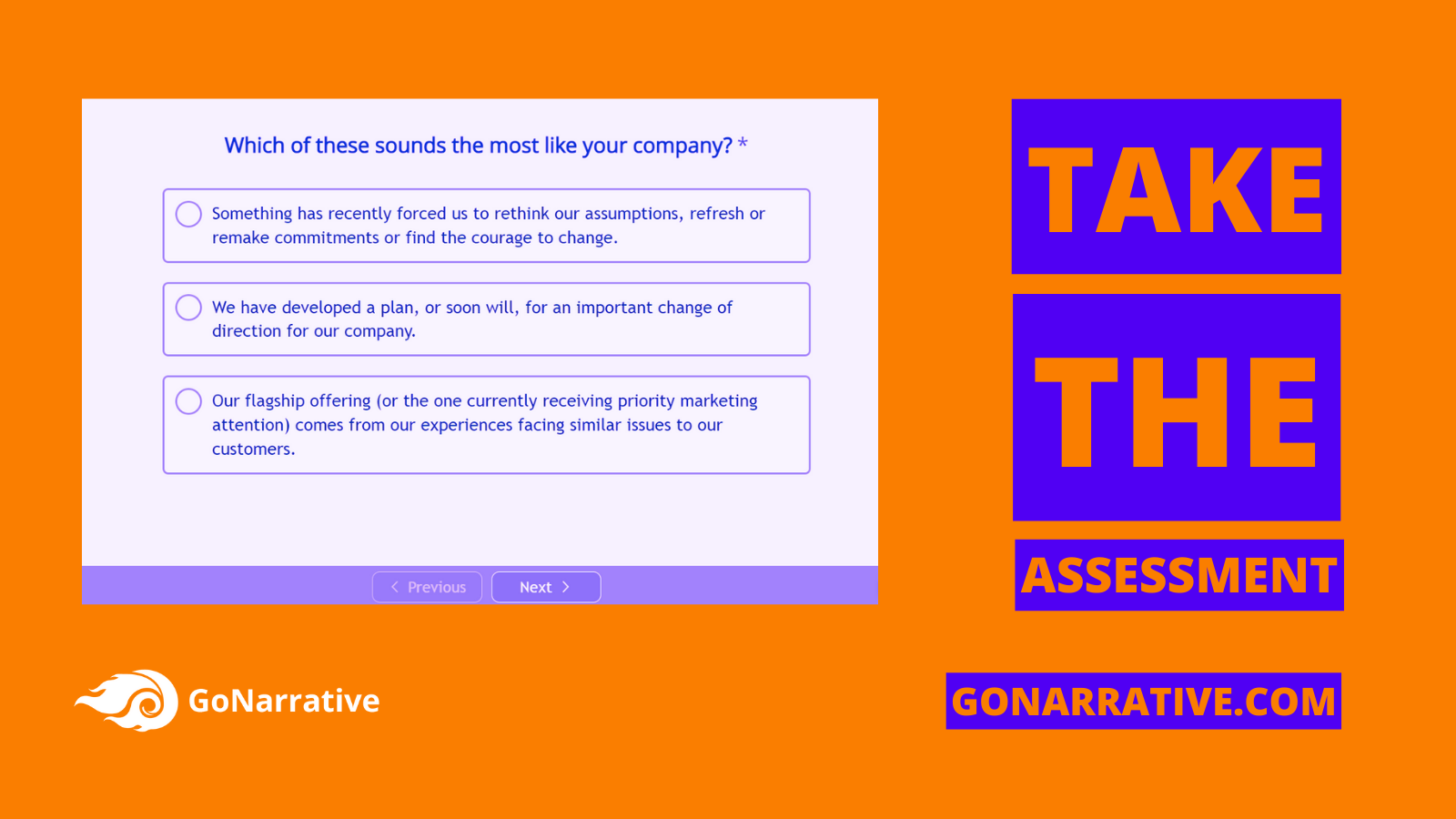
Do you want to discover which powerful story type best aligns with your company's unique obstacles and goals? To start take our simple Business Story Type Assessment and unlock understanding and the transformative power of storytelling for your company and work. Then, book a 20-minute Story Assessment call to talk through our proven tools and techniques for crafting stories for the right people at the right time. Plus, it's a great way to ask us any questions you may have.
If the story only works when you're in the room, that's a symptom.
Book a Narrative Diagnostic