

The Hazmat Test: What the Question You Didn’t Rehearse Is Really Checking
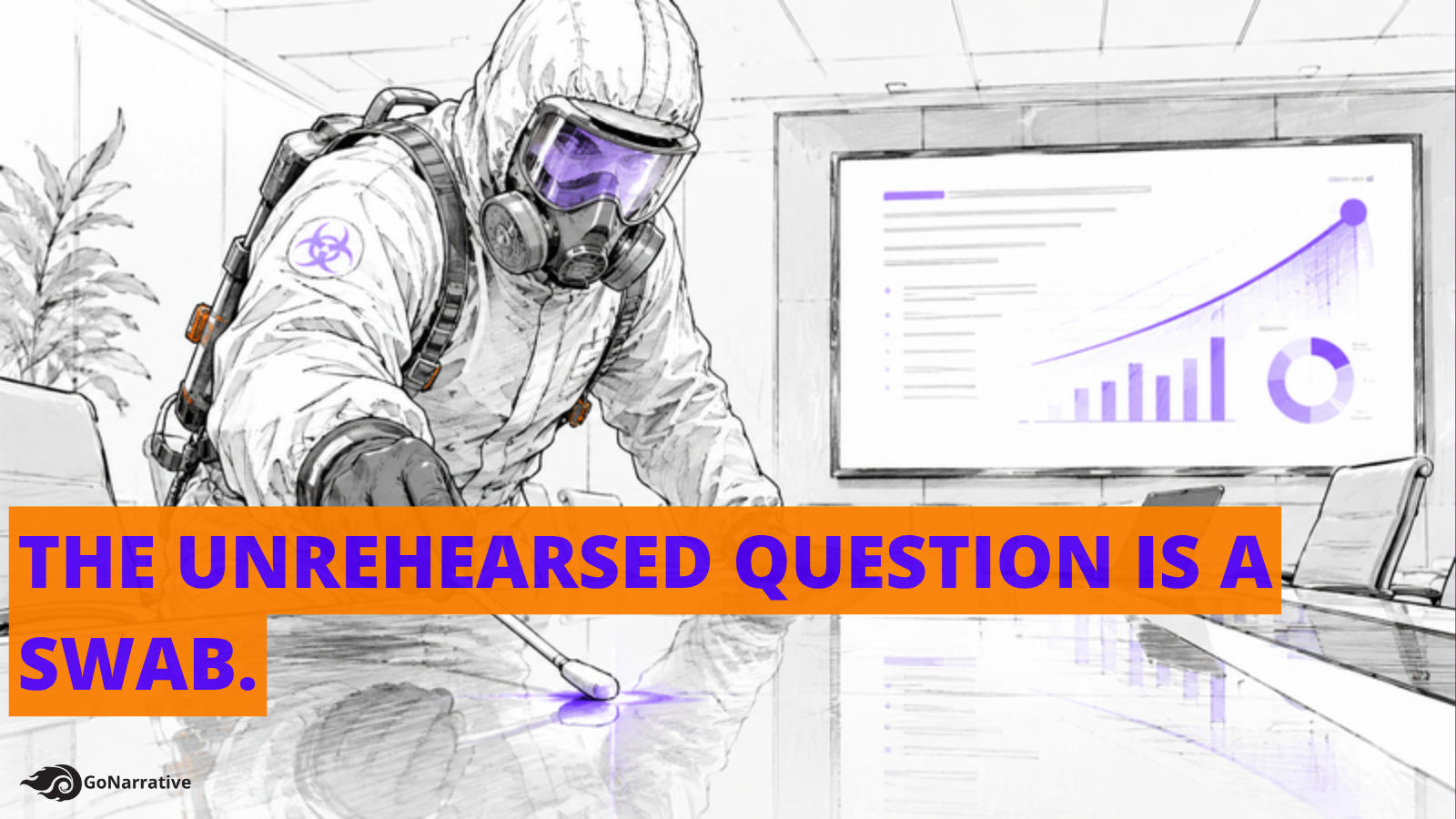
The plane landed in Seattle. The doors didn’t open. There was a muted commotion amongst the flight crew. The seat belt sign stayed on.
“Please stay in your seats.”
My wife and I looked at each other, a shared expression of uncertainty.
Nobody knew what was going on.
We were coming home from the UK after a Christmas with family, two kids under three in tow.
Somewhere over the Atlantic, a group of passengers started getting sick. Vomiting and worse. It spread. My wife and I did what parents of small children do: we wiped everything. Hands, trays, armrests, various surfaces in the WC. We were thorough. We were, we told ourselves, on top of it.
Then we landed, and they wouldn’t let us off.
People in hazmat suits came down the aisle instead. Nobody told us anything. They moved seat to seat, checking, asking, deciding whether the plane was safe to release. We sat there with the wipes still in our bag, having done everything right, waiting for strangers in protective gear to agree.
Our preparation was real, and it was irrelevant. The suits weren’t checking whether we’d wiped the surfaces. They were checking whether the system was contaminated.
Founders and CEOs meet the suits too. Usually at exactly the moment they’re most excited.
Why do investors stay skeptical when the numbers are good?
A founder I worked with walked into his investor meetings buzzing. He walked out with homework: “We need to prove more usage.”
Wrong homework. His numbers weren’t the problem. The investors stayed skeptical because he hadn’t sold the idea. The belief underneath the company never moved from his head to theirs. They were still skeptical.
Belief transfer is my term for that handoff: the point where someone else can hold your company’s idea without you standing there holding it up. It hadn’t happened. So the room did what unconvinced rooms do.
Skeptics stay in argument. They stay in data. They ask for another number, another cohort. The next number won’t settle anything, because nothing has made the numbers mean anything.
More data doesn’t clear a skeptic. It hands them more surfaces to swab.

What tough question are you struggling with?
Most advice treats the curveball like a radioactive potato: hold it carefully, get it out of your hands fast, return to the deck. That framing misses what’s happening.
The question you didn’t rehearse (the market you don’t serve, the comparison you didn’t invite, the hire you haven’t made) is a swab. The investor runs it along a spot you didn’t polish and looks at what comes back.
Rehearsed answers are wiped surfaces. Deck polish, FAQ prep, the beautifully packaged origin story, the roadmap answer you can deliver in your sleep. All of it is wiping. Useful, even necessary. Also beside the point. If the story underneath doesn’t cohere, if sales, product, and you each carry a [even slightly] different version of why this company wins, the swab finds it. You can’t wipe your way past a hazmat team.
The question you didn’t rehearse is the only one that tests whether your story is load-bearing.
What does passing the test sound like?
Different founder, different room, same pressure. The investors liked the company but pushed expansion as a condition of the check: take the money, chase the adjacent market now. He held his ground. What he said (I’m compressing, but this is the shape of it) went like this:
“The change we want to see in the world is this. It’s why we’re going after this market. When we win it, that compounds the truth of what we do. Then, and only then, does the next market make sense. You’re pushing us for growth and scale, but you’re disconnecting growth from why things grow. Our product works. We ship fast. That’s why we made it this far. But you can’t pour five extra gallons into a fifteen-gallon tank and call it a twenty-gallon tank. The extra five spill on the floor. Tying investment to something that doesn’t fit what we stand for is spilling gas on the pavement. You might as well throw a match after it, because all it burns is what people know us for. Brand is what people say when we’re not in the room, and it comes from how we act while we’re in it. So we politely decline your conditions.”
They got the investment.
They also got something rarer: free rein.
Look at what’s in that answer: A belief, stated plainly. A constraint: this market, not that one, and the discipline to say when. Proof already on the record: the product works, the shipping speed is checkable. A mechanism connecting all of it. Winning here compounds the truth of what we do. Now look at what isn’t in it: a single new data point. The all-clear came from coherence, not evidence.
That founder had structure under him. The curveball landed somewhere on a map he already had.
Why is this fatal for a company your size?
Back to the plane. A few days later the sickness ran a sequence: my eldest son first, then my wife. Same symptoms, same interval. So when my own first symptom hit, it was information. I knew exactly what was coming and how long I had. I spent my window on procuring bleach and toilet paper. Hardly a heroic shopping list, but the right one.
Companies get sick too, just not in a straight line. I've watched it in founder-led companies, and I lived it for years on the receiving end inside Intel and Microsoft (my job was carrying an executive's intent to people who'd never meet him).
Three symptoms show up, and they feed each other. Decision decay is when choices that were settled come unsettled and get relitigated. Each round pulls the founder back in, and the delegation tax grows. Work goes out, comes back wrong (the task moved, the thinking didn't), and the founder redoes it at 4am. All that stepping in hides legibility loss. The founder can still explain the company fine, so nobody clocks that people inside and outside the business can't repeat what it believes or who it's for. And a company nobody can repeat starts reaching for new positioning... which reopens the decisions. I can't tell you which one starts it. My first draft of this paragraph put them in a neat order. I wanted one that badly. But life isn’t always so tidy.
At a big company, the sequence is expensive and survivable. At yours, it’s fatal. There’s no fat to absorb it, and it peaks precisely when the suits board: the raise window, diligence, the first real exec hires. My working hypothesis after years of doing this: next to shipping great product, whether your story survives inspection is the most important part of the leadership puzzle.
So the first unrehearsed question that wobbles is your first symptom. Founders, CEOs, leaders who move inside that window fix the structure. Those who don’t go buy more data.

How do you prepare for a question you can’t rehearse?
You don’t stockpile answers. There are infinite questions and one of you.
You make the structure explicit instead. What has to be true for you to win. Who this is for, and who it is not for, even when their money is green. Which tradeoffs you’re actually enforcing, not just stating. What proof exists today, and what proof must exist by the next raise. Why you are doing any of this in the first place. Captured, simplified, distilled, written down, and shared. That goes beyond philosophy and becomes a map. A curveball becomes a question about a map everyone in the company can read. Your team can field it in the rooms you’re not in. So can you, on the day the suits come down the aisle.
Want to know where you stand? Have someone outside the deal ask you the question you’re hoping nobody asks. Watch what you reach for. If the honest answer starts with a belief and a constraint, you’re clear. If it starts with “let me pull the usage data,” you’ve found your gap. And it’s cheaper to find it now than in the aisle seat.
We wiped every surface on that plane and got sick anyway. The wiping wasn’t the failure. Believing the wiping was the system. That was the failure.
What’s the question you’re hoping nobody asks?
If the suits already have a date on your calendar (a raise window, a board meeting, a diligence request), is it worth twenty minutes to find the gap before they do? Book a meeting.
Not ready to talk? The Narrative Drift Assessment will show you which symptom you’re on.
If the story only works when you're in the room, that's a symptom.
Book a Narrative Diagnostic