

Most Series A Companies Never Reach Series B. The Metrics Aren’t Usually the Problem.
The story is.
Not because founders can’t tell it. Because the story worked so well early on that nobody noticed it stopping working. Growth happened. Headcount doubled. A PMM joined and “sharpened” the value prop. A new VP of Sales started running his own version of the pitch.
Six months before the Series B window opens, three different versions of the company are circulating — and the founder is the only one who can feel the gap.
That’s not a messaging problem. That’s narrative debt.
What is narrative debt?
Narrative debt is the gap between what leadership believes and what the organization can repeat under pressure.
It is not a communication failure. It’s a structural one. The story that created early success — the scrappy founding pitch, the tight team who sat in one room — was never built to survive scale. It worked at 10 people because proximity substituted for clarity. Decisions traveled by hallway. Alignment was implicit.
Then the company grew.
What used to be obvious became negotiable. What used to be a clear “no” turned into a debate. And the story that held everything together started carrying weight it was never designed for.
I see this schedule play out consistently in companies approaching Series B:
Six months before the raise: The founding pitch no longer describes the company you’ve actually built. Investors ask questions you’ve already answered. The deck gets rewritten again.
Around 50–75 employees: Messaging fragments. Sales improvises. Marketing publishes a homepage that doesn’t match the deck. New hires absorb the behavior they see — not the decision that was made.
After a pivot: Old storylines linger. The team is still selling a version of the company you stopped being eighteen months ago.
None of this is anyone’s fault. Everyone is rational. Everyone is optimizing for their own context. The problem is that no one is operating from the same set of shared beliefs.

Old storylines, competing storylines, fragmentation.
What is the difference between core and lore?
Every company’s story operates in two layers.
Core is the strategic narrative — the shared set of beliefs and constraints that make decisions portable across the organization. It answers the questions that determine behavior: What must be true for us to win? Who is this not for? What tradeoff are we enforcing? What proof needs to exist by the next fundraise for this story to be credible?
Core is not messaging. It’s the belief structure that makes messaging stable.
Lore is everything built on top of it. Every customer conversation, every demo, every deck, every sales email your team sends without you in the room. Lore is inevitable. Your team is going to build it whether you plan for it or not.
The question is not whether lore happens. It’s whether it’s building on something solid, or fragmenting from a foundation that was never locked down.
When the core is solid, lore compounds. Sales adds texture. Marketing finds angles. Customer success brings it into the relationship. The story extends without losing its shape.
When the core isn’t solid, every new hire adds entropy. Every leadership conversation reopens the same debate. And the founder ends up back in every room, re-explaining a strategy the team should be able to carry.
Why does narrative debt become a leadership problem at 50–75 employees?
Below a certain size, the founder is the story. Proximity carries the belief. When someone is confused, they walk over and ask.
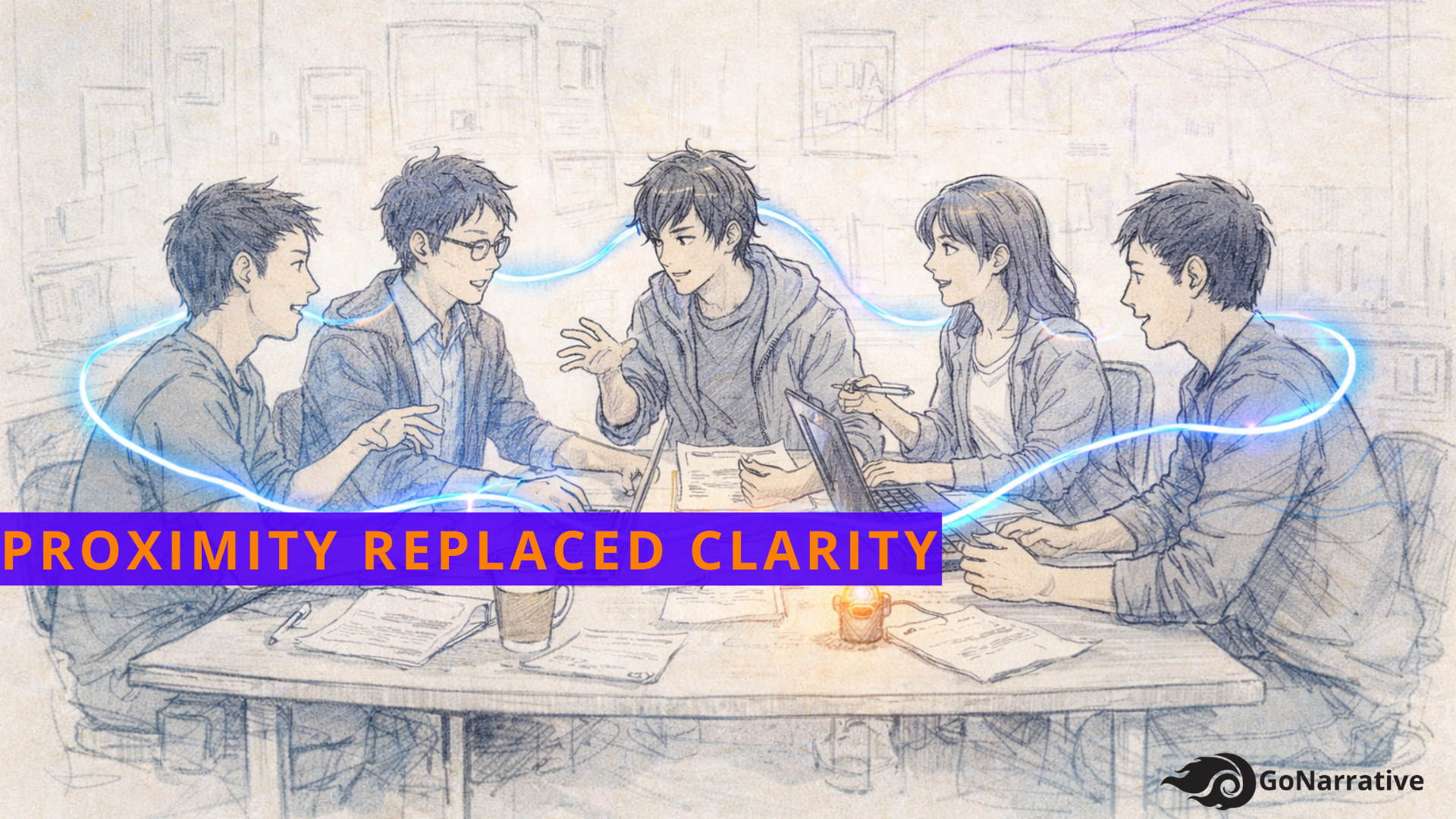
When the founder can be in every room the story is strong.
At 50–75 employees, that stops working.
There are too many people to reach by proximity. Decisions are being made in rooms the founder isn’t in. New hires are being onboarded by other new hires. The story is now being transmitted secondhand — and each retelling introduces interpretation.
The result: the story lives in one person’s head instead of in the system.
That’s the bottleneck. Not execution. Not talent. The narrative hasn’t been extracted from the founder and encoded into the organization in a form people can operate from independently.
This is why founders at this stage describe the same symptoms: “I’m in every decision.” “We keep having the same argument.” “My team is working hard but nothing is moving.” “I can feel the company drifting but I can’t point to anyone doing anything wrong.”
They’re right. Nobody is doing anything wrong. The story is just not in the system yet.
How do you diagnose narrative debt before it costs you the raise?
Ask this before your next campaign, your next deck revision, your next offsite:
If we had perfect positioning today, what would still break in thirty days?
The answer tells you which failure mode is dominant:
If the answer is “people would reinterpret it” — the core doesn’t compress. People encounter the story and leave with different versions of it. That’s a legibility problem: the story doesn’t survive retelling.
If the answer is “it wouldn’t survive without me in the room” — the core doesn’t travel. It requires the founder to deliver it, enforce it, translate it. That’s a delegation problem: the story lives in one person, not in the system.
If the answer is “we’d revisit it again at the next board meeting” — the core doesn’t hold. Decisions made today dissolve under pressure in thirty days. That’s a decision problem: the story can’t make choices stick.
If the answer is all three, that’s narrative debt. And it doesn’t fix itself.

You need something that ties all stories together.
What changes when narrative debt is resolved?
Teams describe the company the same way without rehearsal.
Decisions compress instead of multiplying. The same argument stops returning every six weeks. Sales closes without the founder on the call. New hires onboard faster because the “why” is in the system, not locked in one person’s head.
The founder stops rewriting the deck. Stops correcting the team. Stops feeling the company slowly escape their grip.
Scaling isn’t about adding slides. It’s about building the belief structure those slides run on.
If your story is starting to fragment — or you’re 6–9 months from a raise and not sure the story is ready — book a 20-min narrative diagnostic.
If the story only works when you're in the room, that's a symptom.
Book a Narrative Diagnostic