

Category Collision: What Happens When Your Product Outgrows Its Story
A founder showed me his product last week.
Not pitched it. Showed it — screen share, click by click — because he couldn’t explain it in words.
Not because it was bad.
Because it had become too many things.
Three product lines. Three buyer categories. Three different budget owners inside the customer’s org. Their homepage read like a restaurant menu — each dish solving a real problem, none of them connected by a single belief.
He didn’t have a messaging problem. He had a category collision.
What is category collision?
Category collision is what happens when a product expands into multiple markets before the narrative catches up.
It’s not rare. It’s the predictable result of good product decisions made without a story to hold them together.
I see this most often in companies approaching Series B — typically somewhere between 50 and 100 employees, after a second or third product line has shipped and the founding story has stopped describing the company that actually exists.
The symptoms show up before most founders name them:
Sales needs a demo to explain the product instead of a sentence
Investors hear three pitches in one meeting and tune out after the first
The homepage reads like a capability list instead of a reason to believe
New hires take months before they can explain what the company does
The part that really hurts: each category maps to a different budget line inside the buyer’s company. You’re not just competing with other vendors. You’re competing with yourself for attention.
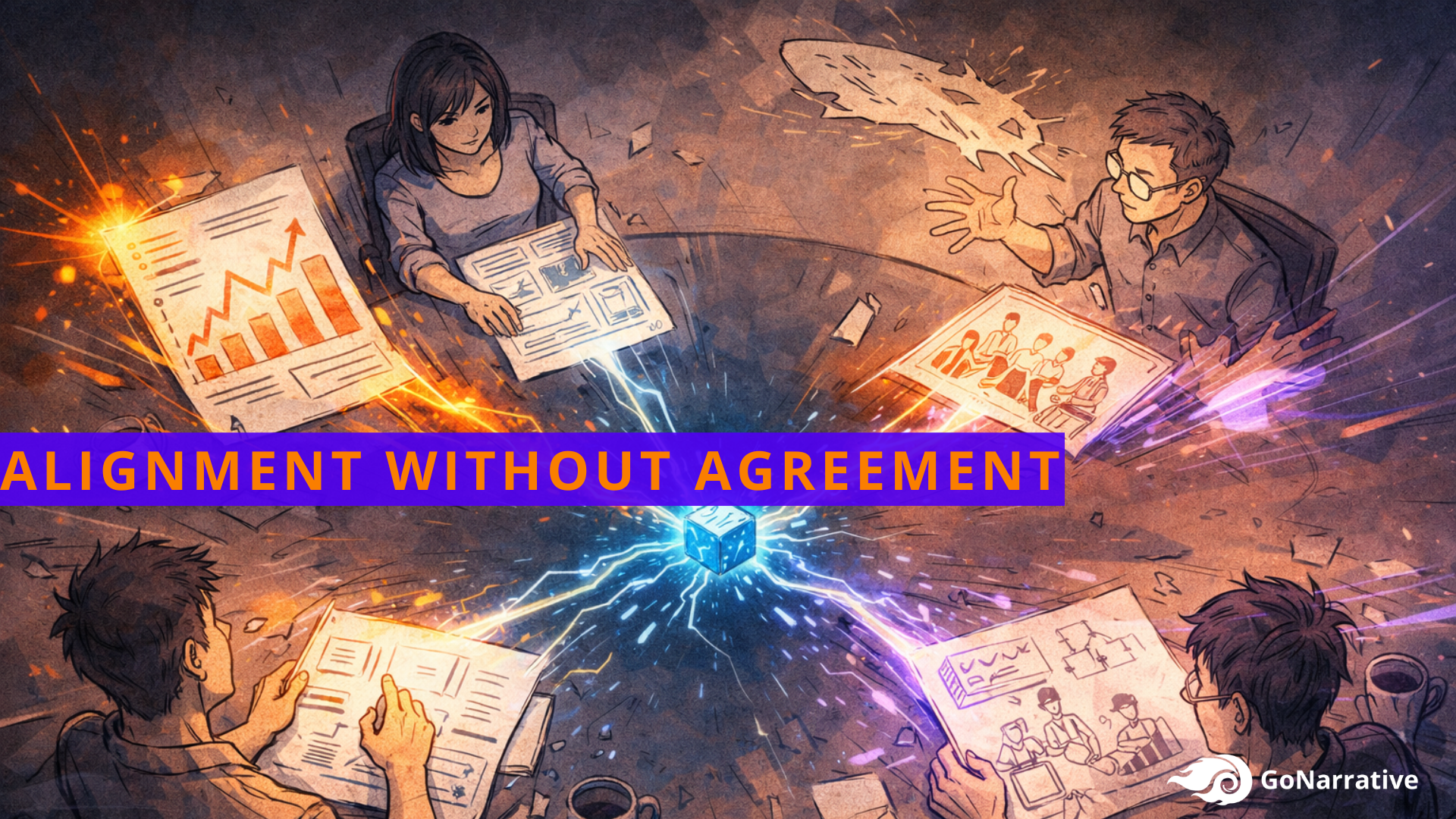
Alignment is not agreement. Alignment is constraint.
Why does category collision get worse as a company scales?
Two forces compound it.
The first is team growth. At 15 people, the founder is still in most rooms. Story drift gets corrected by proximity. At 60 people, that stops working. Sales, marketing, product, and customer success are each telling the story through their own lens — and nobody has a mandate to reconcile the versions.
The second is content volume. AI made content easy. Every team is publishing more. When everyone is producing more, volume stops being an advantage. The only filter left is trust.
Trust comes from coherence — from a market that hears one consistent story across every function. When those functions describe the company differently, the market doesn’t do the reconciliation work. It moves on.
Category collision accelerates this. The more your product does, the more surface area there is for the story to fragment. Every new capability is another chance for the team to go off-script.
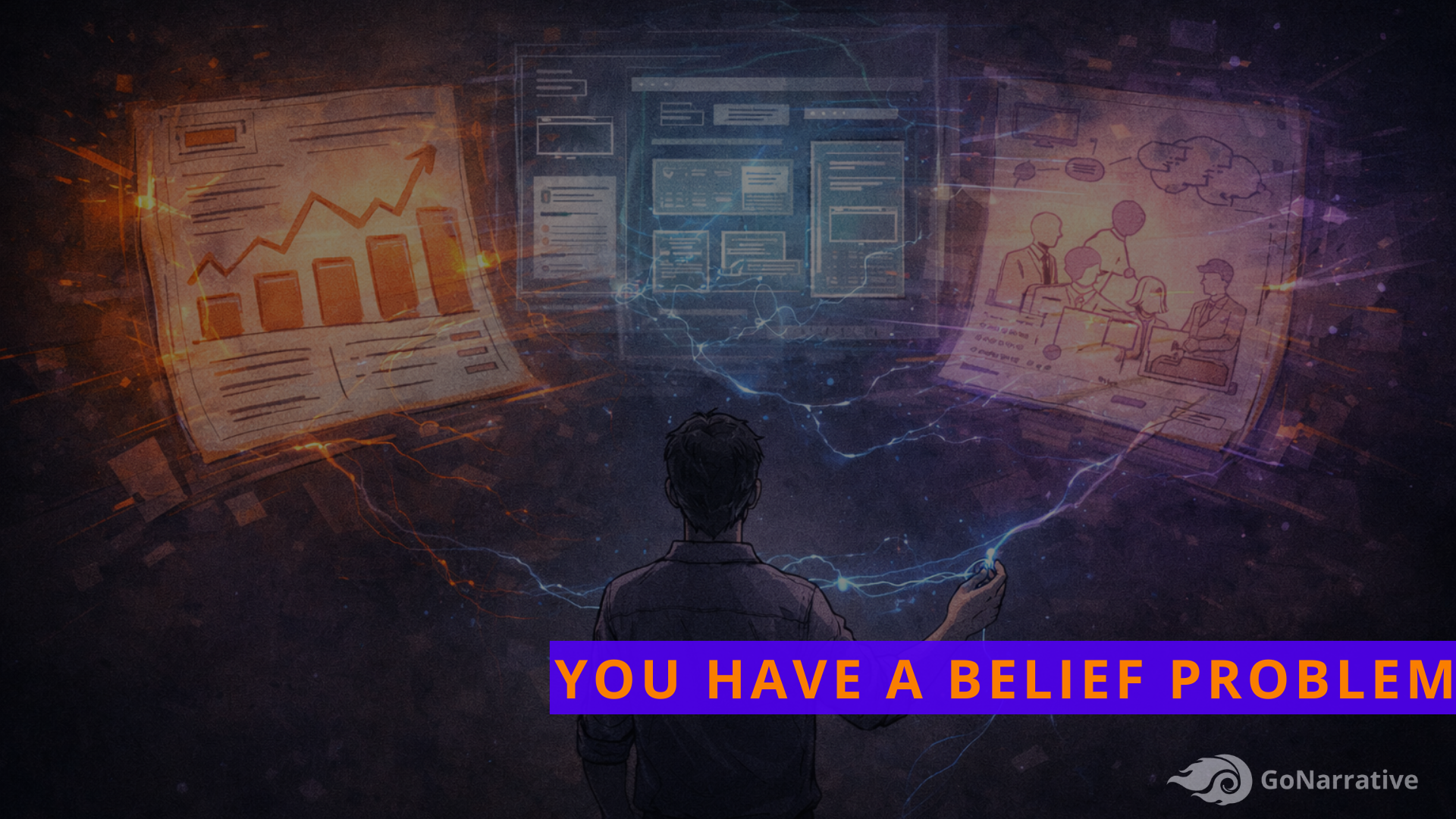
Without belief everything is harder
How do you know if you have a category collision problem?
Run this diagnostic before assuming the problem is messaging.
Ask five people on your team — across functions — two questions:
What do we do? Why does it matter?
If you get five different answers, you don’t have a content problem. You have a belief problem. The story isn’t shared — it’s improvised by everyone who touches it.
A faster version: ask a new sales rep and a senior CSM to explain the product to a prospect. Watch what’s different. That gap — between what sales leads with and what customer success reinforces — is where the category collision lives.
Three more signals worth checking:
Would a new rep explain the value the same way as a customer who’s been with you two years?
Does your investor pitch describe the same company as your onboarding docs?
If someone read your homepage and then sat through a demo, would they feel like they were buying the same product?
If the answer to any of those is no, the story has already fragmented. The market is absorbing three versions of you and choosing none of them.
What is the fix for category collision — and why isn’t it simplification?
The instinct when you have three product lines is to kill one. That’s the wrong move most of the time.
Those product lines exist for good reasons. They’re solving real problems for real buyers. Consolidating them doesn’t fix the story — it just reduces the footprint.
The fix is finding the one belief that makes all three product lines inevitable.
Not a tagline. A belief. The thing that, once someone accepts it, makes every line of the product make sense as a single bet on how the world works.
The test: Can you say in one sentence what must be true about the world for all three of your products to exist?
Not what they do. What has to be true for them to matter.
If you can’t say it in one sentence, your team can’t either. And if your team can’t say it, your market can’t either.
Without that belief, you’re asking prospects to do the integration work in their heads. Most won’t. They’ll pick the one thing they understand and ignore the rest. Or they’ll leave.

Decoding and integrating the one belief
What changes when you find the one belief?
The one belief doesn’t replace the three product lines. It connects them.
Sales stops demoing and starts making a case. Marketing stops describing capabilities and starts building conviction. Customer success stops explaining features and starts reinforcing a worldview.
The homepage stops reading like a menu and starts reading like a point of view.
Investors stop hearing three pitches in one meeting. They hear one bet, made three ways.
Where does category collision show up first?
The homepage. Always.
If your website reads more like a feature catalog than a conviction, the category collision is already visible. The story grew faster than the team noticed, and now the market is the one paying for it.
This is diagnosable before a raise. It almost never fixes itself.
What’s the one belief underneath your product portfolio?
If your team is telling different stories about what you do — or you’re heading into a raise and not sure the story holds — book a 20-min narrative diagnostic.
If the story only works when you're in the room, that's a symptom.
Book a Narrative Diagnostic