

Business Storytelling Isn’t What You Think
It’s not a communication trick. It’s the operating system your company runs on—whether you designed it or not.
Most people searching for “business storytelling” are looking for technique. A better hook. A more compelling case study structure. A framework to drop into the next deck.
That’s not what this is about.
Business storytelling is the structural pattern the brain uses to take in and hold information. Not a creative approach — a cognitive one. Every company is already running a story beneath its strategy, its sales conversations, its hiring pitches. The only real question is whether someone built it that way on purpose, or whether it just accumulated.
The difference shows up fast. When the story is built deliberately, decisions compress. Teams move without being told what to do. Investors retell it accurately to their partners. When it isn’t, you get the same argument every six weeks in slightly different words, deals that need the founder on every call to close, and a homepage that’s been rewritten four times without ever quite landing.
This piece covers what business storytelling actually is at a structural level, why most companies get it wrong, and what starts breaking when a company scales past the story that got it there.
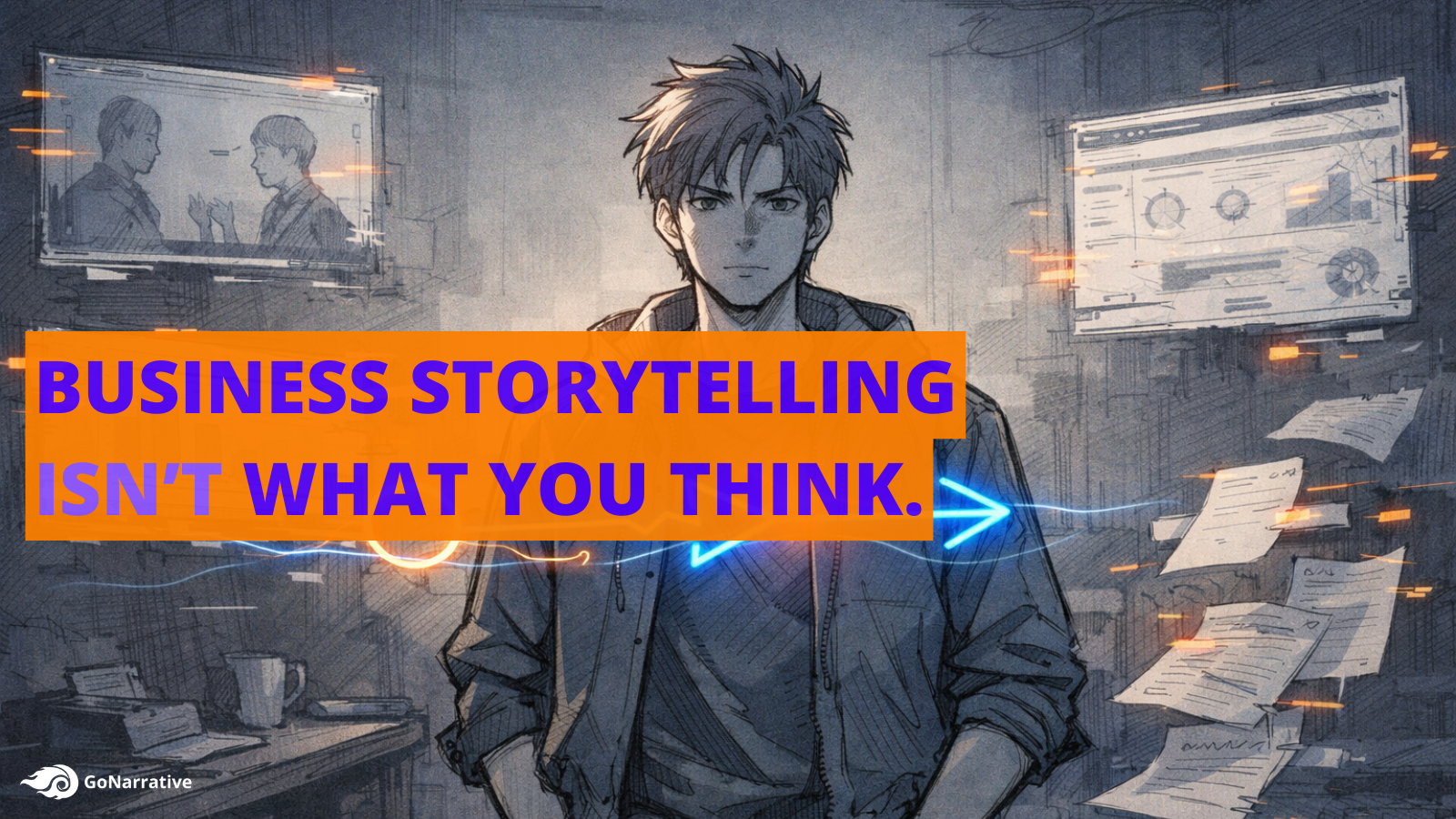
Founder with swirling concepts of storytelling flying around them
What Business Storytelling Actually Is
Here’s what storytelling in business actually is — not a genre, not a writing style, not a creative skill some people happen to have. It’s the structural pattern the brain uses to take in, hold, and recall information.
There’s research on this. Narrative cognition studies consistently show the brain retains information delivered in story structure at significantly higher rates than the same information presented as facts or lists. That’s not a soft observation about human connection. It’s a reliability gap. When the message follows the pattern, it sticks. When it doesn’t, it has to be said again, slower, twice.
The practical consequence: every pitch deck, sales call, investor update, and job description either follows this pattern or fights against it. You don’t add storytelling to your communication. You either structure your communication the way the brain processes it, or you don’t.
The practical implication: you don’t need to become a storyteller. You need to understand the structure your audience’s brain is already looking for, and build your message to match it.
The Three Elements That Make a Business Story Work
Effective business stories share three structural elements. Miss one, and the story collapses. Get all three right, and the message becomes portable—it travels without you in the room.
1. Desire: What Your Customer Actually Wants
Every story starts with someone who wants something. In business, that’s your customer—not your product. The desire isn’t a feature request. It’s the business outcome they’re trying to reach, the problem they need solved, or the future state they’re working toward.
Most companies skip this. They start with what they built instead of why someone would care. A network security company doesn’t start with their platform’s capabilities. They start with the CISO who needs to sleep at night knowing a breach won’t end their career.
2. Difficulty: What’s Actually in the Way
Remove the obstacle and you’ve lost the audience. Difficulty is what gives a story somewhere to go.
In business, this means the specific friction standing between your customer and what they actually want — not friction in the abstract. The compliance requirement adding six weeks to every deal. Data sitting in four systems that don’t talk. A process that made sense three years ago and now just runs, because nobody stopped to ask why.
That last one is worth a pause. People living inside a broken process long enough usually stop seeing it as a problem. It becomes normal. And normal is where the most interesting business stories live — the obstacles so familiar nobody’s named them yet.
The mistake most companies make here isn’t getting the difficulty wrong. It’s keeping it abstract enough to feel safe.
“Our customers struggle with complexity.” Sure. So does every company in every category. That’s not a difficulty — it’s a placeholder.
The version that actually sticks is specific enough to make one reader feel seen. Specific enough that it probably won’t resonate with everyone. That’s the trade-off. It’s worth making.
3. Direction: The Path That Only Exists Because of the Difficulty
Direction is where most companies overcorrect.
The temptation is to plant the product here. Difficulty named, solution arrives, problem solved. But that move collapses the story — it makes the company the hero and pushes the customer out of the frame.
Direction isn’t the rescue. It’s what becomes visible once the difficulty has been given a proper shape. Your customer couldn’t see the path before — not because they weren’t smart enough, but because nobody had named the obstacle clearly enough to show it. Once that happens, the next step becomes obvious. Your job is to show the path, not perform the arrival.
This three-part structure—Desire, Difficulty, Direction—is the foundation of Go Narrative’s Power of 3D Story™ method. It works because it maps to how the brain processes information, not because it’s a clever framework.
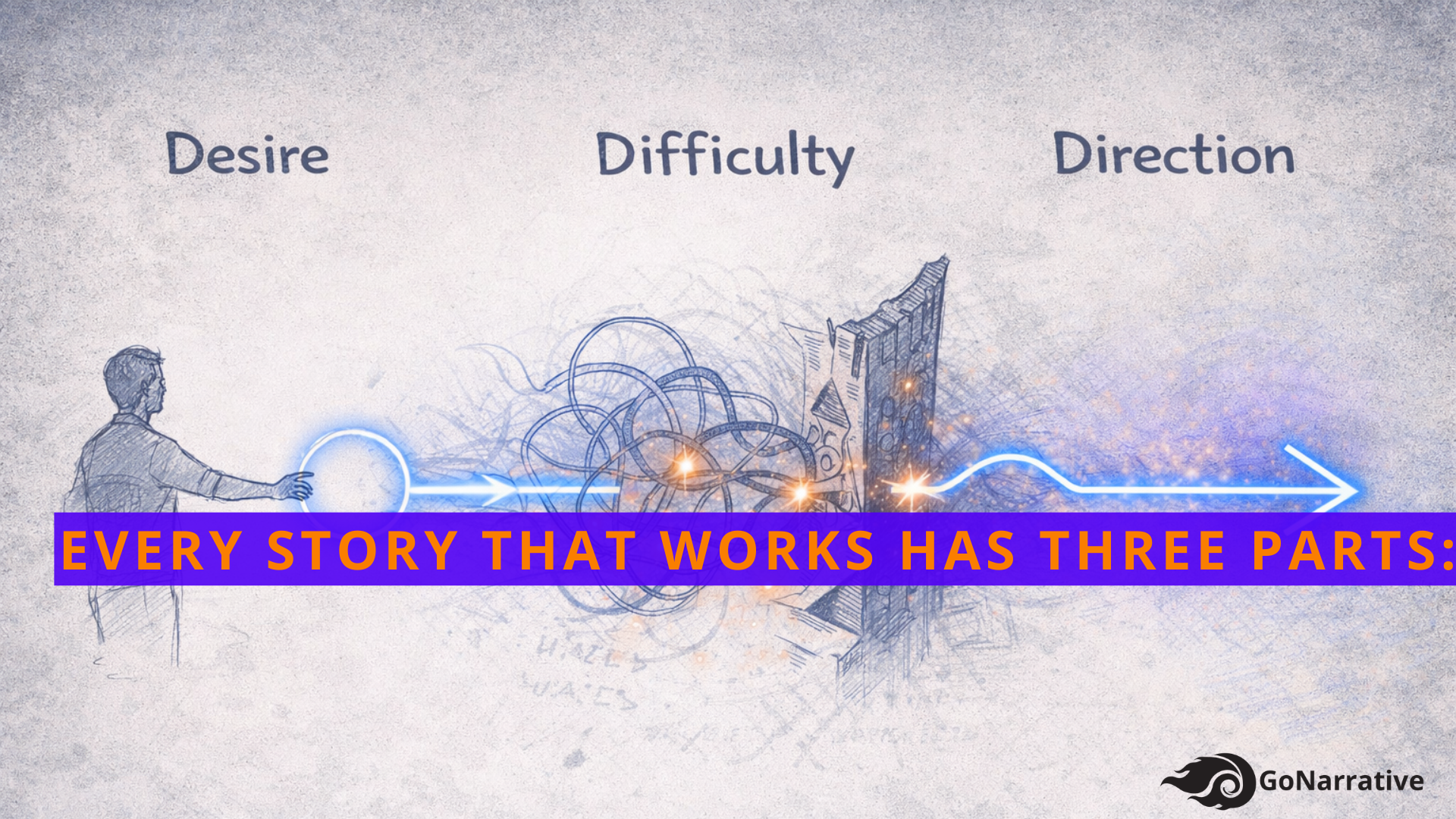
Diagram showing business storytelling as desire, difficulty, and direction
Why Most Companies Get Business Storytelling Wrong
There are two failure patterns that account for most broken business stories.
The Curse of Knowledge
There’s a specific failure mode that hits technical founders harder than most: the more deeply you understand something, the harder it becomes to explain it to someone who doesn’t.
Psychologists call it the curse of knowledge. In practice it looks like pitch decks written in the language of the architecture, not the outcome. Sales teams who answer questions nobody asked. Marketing copy that explains the product to an audience that hasn’t decided to care yet.
The assumption underneath all of it: the audience is already with you. They’re not. They’re still deciding whether any of this is worth their attention.
Stories cut through this because they force concrete language. You can’t tell a story about “digital transformation.” You can tell a story about a warehouse manager who lost three days every month reconciling inventory across systems that don’t talk to each other. The specificity is the signal. When someone recognizes themselves in your story, they listen. When they don’t, they move on.
Leading with the Company Instead of the Customer
The second failure is centering the story on the wrong character. Most companies start with what they built, how it works, and why they’re different. They talk about themselves for the first 80% of the pitch and add the customer at the end.
The brain pattern runs the opposite direction. Your audience needs to see themselves first—their situation, their stakes, their frustration. Only after that recognition lands do they give you permission to talk about your solution. Earn that permission by demonstrating you understand their world. Skip it, and you’re talking to an audience that’s already stopped listening.
What Happens When a Company Outgrows Its Story
Every company starts with a story, even if no one writes it down. In the early days, it’s implicit. Everyone sits in the same room. Decisions travel by proximity. The founder’s conviction holds everything together.
Then the company grows.
What used to be obvious becomes negotiable. What used to be a clear “no” turns into a debate. What used to hold under pressure starts to drift. This is where most companies discover that their story was never built to scale—it was built for a room of five people who already shared the same assumptions.
The result is what practitioners call narrative debt: the gap between what leadership believes and what the rest of the organization can repeat under pressure. It shows up as:
The founder stuck in every sales cycle because deals only close when they’re on the call
The same strategic debates returning every six weeks in different words
Three people on the team explaining the company three different ways
A pitch deck that gets rewritten quarterly but never lands
Investor diligence dragging because the story doesn’t cohere across conversations
From the inside, none of this announces itself as a story problem. It reads as execution lag, or a hiring issue, or a leadership alignment gap. The naming matters because if you call it the wrong thing, you spend time solving the wrong thing.
The consistent pattern: the story works when the founder is carrying it. Step them out of the room, and some version of the message degrades. Which means the story was never portable — it was dependent on one person to hold it together.
For companies between Series A and Series B, this gets expensive fast. Typically 50 to 75 people, $2–3M ARR, six to nine months from the next raise. At that stage, narrative debt shows up in concrete ways: missed hires who couldn’t be convinced without the founder on the call, investor follow-ups that dragged because someone in the partner meeting heard a different version of the company.
The Compression Test: A Diagnostic for Story Health
Here’s a fast way to know whether your company’s story is working:
Ask five people on your team: “What do we do, and why does it matter right now?”
If the answers rhyme—if they share the same core logic even when the words differ—your story compresses. It’s portable. It will travel.
If the answers diverge — one person leads with the product, another with the market, another with the mission — that gap is your diagnosis. Not a communication training problem. A story without a shape that survives retelling.
What happens next is predictable: every new person who joins inherits a slightly different version depending on who onboarded them. The story fragments a little more each time it changes hands.
A second diagnostic: ask yourself this question and answer it honestly.
If we had perfect positioning today, what would still break in thirty days?
If the answer involves people reinterpreting the message, revisiting the same decisions, or the story degrading when you’re not in the room—that’s not a positioning problem. That’s a structural story problem.
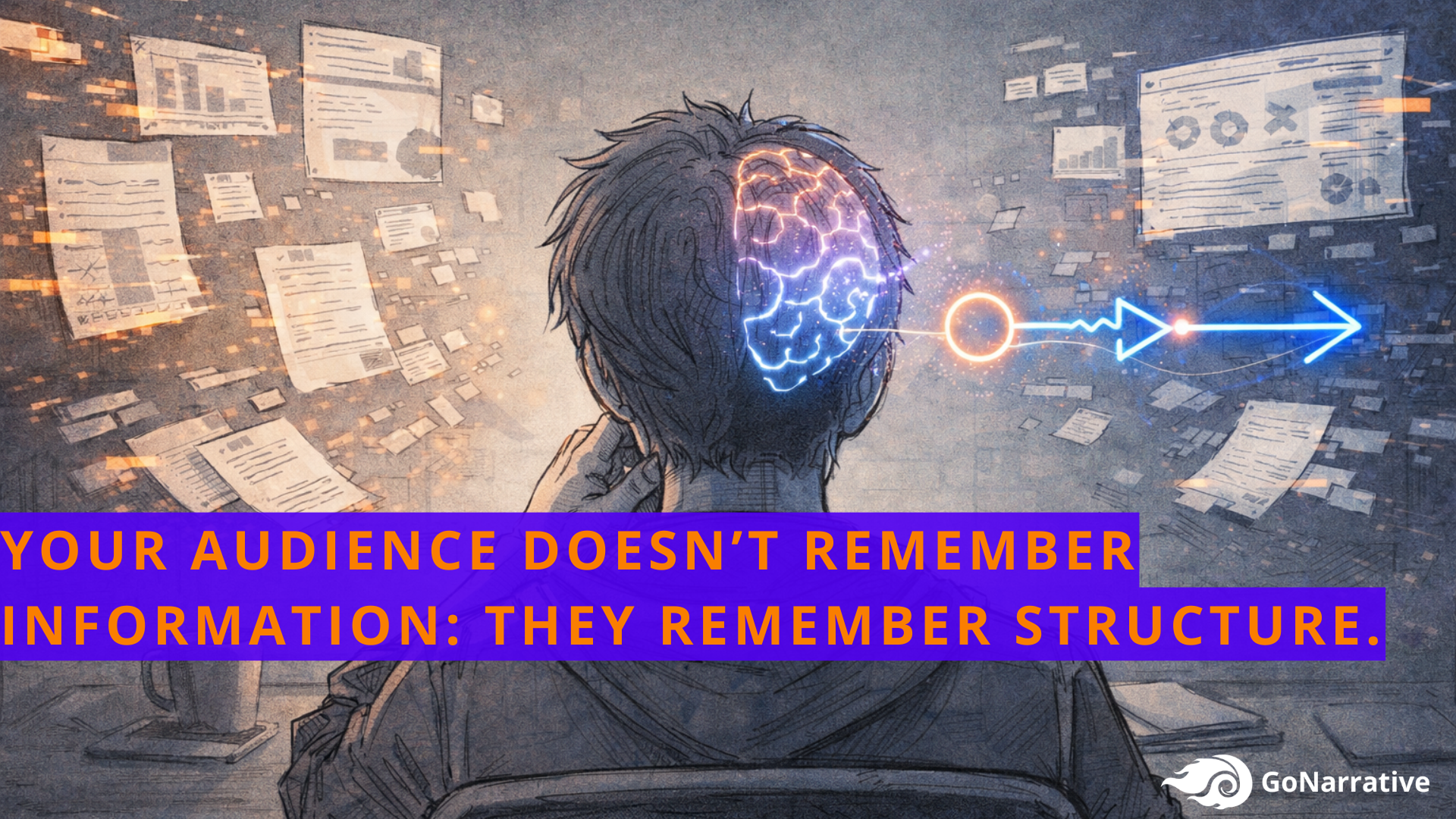
Representation of how the mind works: based on structure, not information alone.
Core and Lore: Why Business Stories Have Two Layers
There’s a distinction most companies skip over, and it’s the reason the same messaging problems keep coming back.
Business stories run on two layers. The first is core — not the deck, not the copy, not the positioning statement. Core is the belief structure underneath all of that: the few things that must be true for the company to win, who you’ve decided this isn’t for even when saying no costs revenue, the tradeoffs you’re actually holding rather than just listing.
The second layer is lore. Everything built on top of core: the sales demo, the investor deck, the homepage headline, the job post for the next VP of Sales. Every company generates lore constantly. That’s fine. The question is whether it all points at the same thing.
When core is clear, lore converges. People produce different artifacts — different words, different formats, different audiences — but the underlying logic holds. When core is missing or fuzzy, every artifact becomes its own interpretation. That’s how you end up with a CEO who says one thing, a sales team that says another, and a homepage trying to split the difference.
Most storytelling help targets lore: cleaner decks, sharper copy, better case studies. That work isn’t wasted. But a more polished artifact built on a broken belief structure is still pointing in the wrong direction.
How to Build a Business Story That Holds Under Pressure
If your company’s story is showing cracks, here’s where to start:
Start with the customer, not the product. Map Desire first. What does your customer want that they can’t get without your category existing? Not your features—the outcome.
Name the difficulty with teeth. Generic obstacles produce generic stories. Find the specific friction your customer faces—the one where they read your description and think “that’s my Tuesday.”
Position your solution as direction, not rescue. Your product isn’t the hero. It’s the thing that makes a new path visible. Frame what becomes possible, not what your technology does.
Run the compression test. If five people on your team can’t tell the same story in one sentence, your core isn’t set. Fix that before you rewrite anything else.
Build core before polishing lore. A better deck won’t fix a broken belief structure. Get the three or four load-bearing constraints right, and the rest follows.
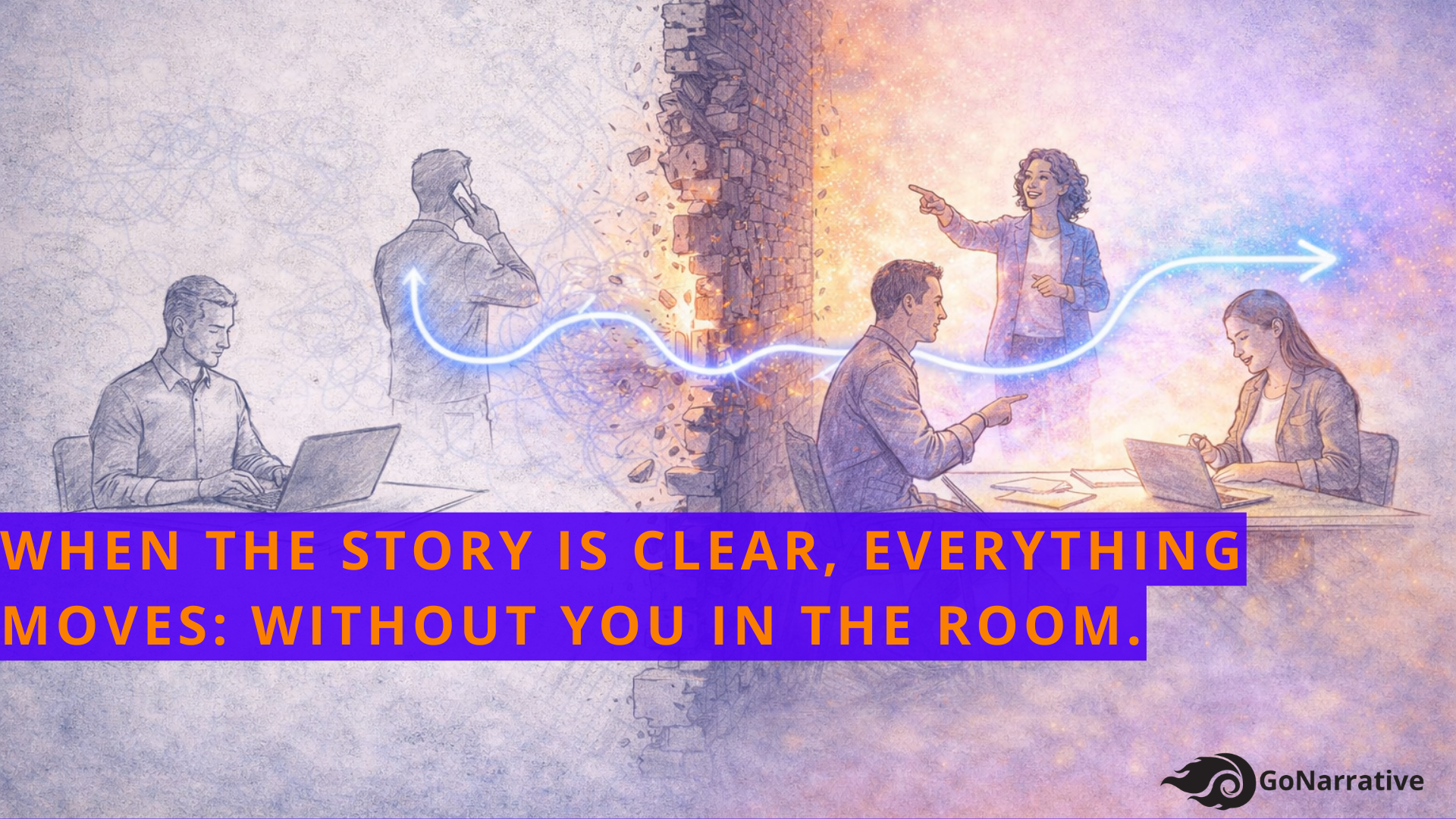
Representation of direction breaking through the wall and leading those we need to follow us to take action.
The Bottom Line
Business storytelling is not a soft skill. It’s the structural pattern that determines whether your company’s message survives contact with people who weren’t in the founding room.
When the story is right, decisions compress. Teams align without rehearsal. Sales closes without the founder on the call. Investors retell the story to their partners without distortion.
When the story is wrong—or when it was never built on purpose—every surface-level fix decays within weeks. New positioning. New deck. New workshop. Thirty days later, the same arguments return.
The difference between companies that scale smoothly and companies that thrash isn’t strategy. It’s whether the story underneath the strategy was designed to hold.
Frequently Asked Questions
What is the difference between storytelling and narrative in business?
Think of storytelling as the act and narrative as the architecture behind it. Storytelling — using desire, difficulty, and direction — is how you carry a message across in a given moment. Narrative is the layer underneath: what the company actually believes, who it’s for, what it’s committed to holding. A company can run compelling presentations while three different teams tell three different versions of the company. The narrative is what has to hold for the storytelling to stay consistent across all of them.
How is business storytelling different from marketing copy?
They operate at different levels. Marketing copy is a finished artifact — the headline, the email, the product page. Business storytelling is what determines whether that artifact lands or slides off. Copy that follows story structure tends to work because it starts where the reader actually is, names something real that’s in their way, and shows where they could go. Copy that leads with features is asking the reader to do the translation themselves. Most don’t bother.
Can business storytelling be learned, or is it a natural talent?
It’s a structure, not a talent. The Desire-Difficulty-Direction framework works regardless of whether you consider yourself a “storyteller.” Engineers, founders, and technical leaders often produce the best business stories because they think in systems—and story structure is a system.
What is narrative debt and how does it affect growing companies?
Narrative debt is the gap between what leadership believes and what the organization can articulate under pressure. It accumulates as companies grow beyond the founding team. Every new hire, new product line, and new market creates an opportunity for the story to fragment. Companies between Series A and Series B are especially vulnerable because they’re scaling teams faster than the implicit story can travel.
How do I know if my company has a storytelling problem?
Run the compression test: ask five people on your team what the company does and why it matters. If the answers don’t rhyme, you have a story problem. Other signals include: the founder needs to be on every sales call to close, the pitch deck gets rewritten every quarter, investors keep asking the same follow-up questions, and new hires take months to explain the company with conviction.
About the Author
Matthew Woodget is the founder of Go Narrative, where he works with post-Series A founders whose growth has outpaced their story. He spent 20 years inside Intel, Microsoft, and Google building and managing narratives across hundreds of stakeholders, including serving as Chief Storyteller for a major Microsoft division. He now helps scaling companies harden their narrative into shared constraints that teams can operate from—without the founder in the room.
Find out where your story breaks: Book a 20-minute narrative diagnostic