

What Breaks a Company’s Story When It Starts Scaling?
AKA: The True Cost of Speed
The problem isn’t your tools. It’s what your tools are amplifying.
You don’t have a tools problem.
You have a belief transfer problem.
What Is Belief Transfer?
Belief transfer is the active process of moving conviction from the founder’s mind into the organization — so the team, investors, and customers can operate from it under pressure, without you in the room.
When it works, speed creates momentum.
When it breaks, speed amplifies every crack.
I see this most clearly in founders approaching Series B. The product is real. The numbers are moving. But something slips. Deals stall. Internal messaging fragments. Investors keep asking clarifying questions they’ve already received answers to.
That’s not a communication problem. That’s belief transfer failing at scale.

Belief Holds a Company Together - Test and Refine Yours Like an F1 Car in a Wind Tunnel
Why Does Scaling Break Belief Transfer?
Years ago, at Microsoft, I managed the global partnership with the Lotus F1 Team. What stayed with me wasn’t the glamour — it was watching belief systems collide under pressure.
One meeting. One line:
“Are you kidding? We’re already spending how much? And you think we should spend more?”
On the surface, a budget argument. Underneath, a collision of two incompatible beliefs about how value is created.
One person was running line-item thinking. The other was running system thinking.
Line-item belief: every cost is a burden. System belief: some costs are incomplete without their adjacent investment. A Dynamics license without implementation isn’t frugal — it’s waste. Activation is to sponsorship what implementation is to Dynamics.
I didn’t rewrite the slide. I reframed the belief.
That one line shifted the conversation. Not because it was clever. Because it connected to a belief the other person already held — in a different context — and made it portable.
That’s how belief transfer works. You don’t give people new information. You give them a belief they already carry, applied to a new situation.
F1 makes the stakes obvious: at 200mph, the smallest misalignment between what the driver believes and what the car is doing isn’t a rounding error. Companies work the same way.
What Does Belief Transfer Look Like When It Breaks?
A founder came to us with a financial trading platform. Details changed for privacy.
Their pitch was mechanically tight:
“You’ll have more control and insight so you can make the right decisions for your family.”
Accurate. Precise. Not moving anyone.
That’s the belief transfer gap in action. The founder knows exactly why this matters — they’ve lived it. But the language they’ve trained themselves to use has been cleaned of the thing that makes belief transferable.
I didn’t rewrite it for them. I asked one question. Then waited.
Their language shifted after the pause. Not polished — raw.
Hope. Dreams. Experiences. Memories. Making moments matter.
Mechanics-only language tells people what the product can do. Human truth shows them why it matters enough to act.
That shift is where belief transfer begins. Not with a slogan. With the founder reconnecting to what they actually believe.
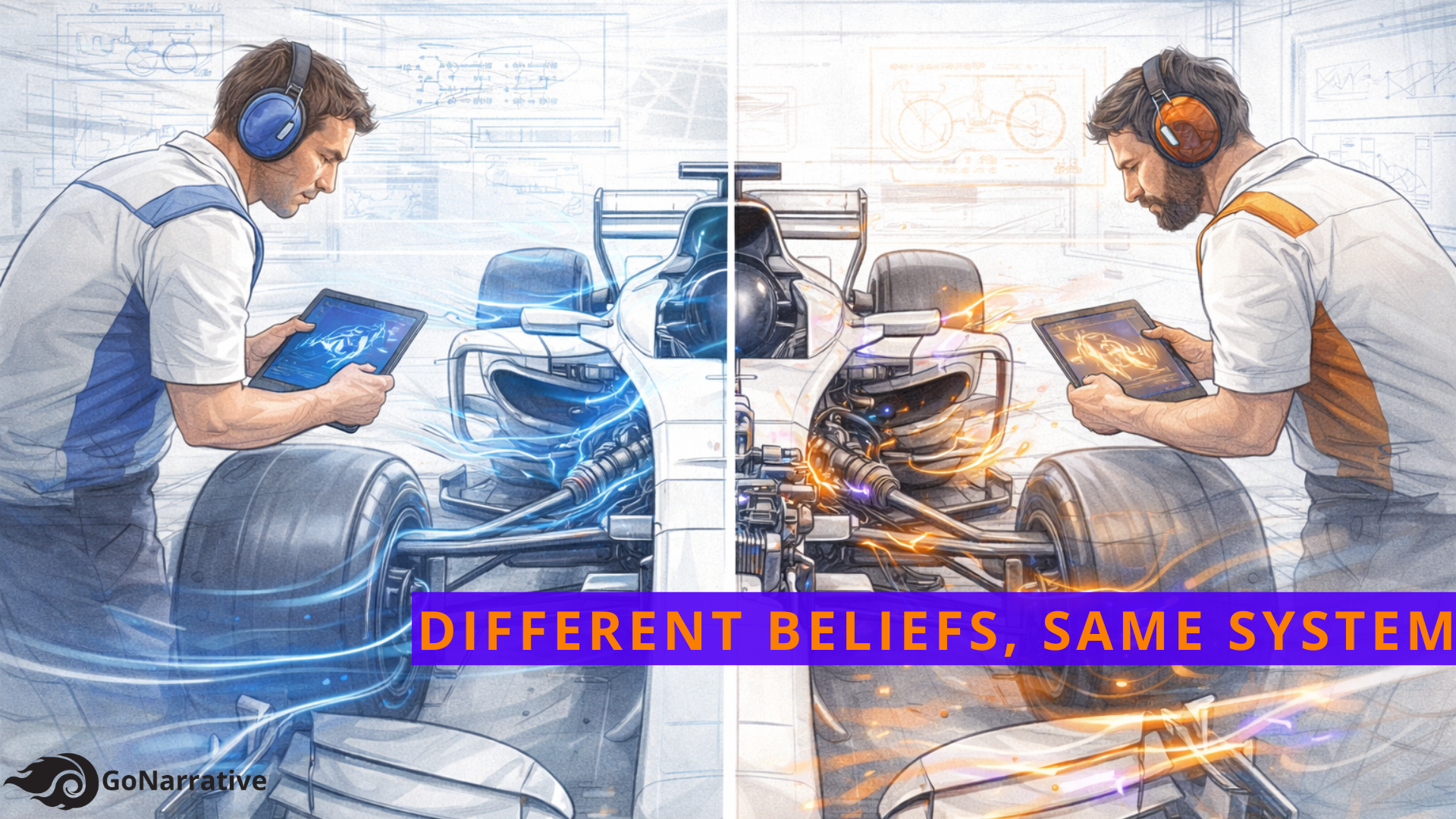
The Moving Components of an Org Create Friction Without Alignment
Why More Tools Don’t Close the Belief Transfer Gap
When belief transfer breaks down, founders reach for horsepower.
More tools. More features. More content. More AI. More explaining.
Tools are real. I’m not against them.
But tools amplify whatever belief system is already running.
If the belief system is coherent, speed looks like momentum. If it’s incoherent, speed looks like wobble.
Adding a CRM to a sales team that can’t explain the company the same way twice doesn’t fix the problem. It scales it.
How Do You Know If Belief Transfer Is Breaking Down?
These are the signals I watch for in companies between Series A and B:
Three people on your team explain the company three different ways.
Deals only close when you’re on the call.
Investors keep asking clarifying questions they’ve already been sent answers to.
New hires take months before they can speak about the company with conviction.
Your homepage gets rewritten every quarter and still doesn’t quite land.
None of these are tool failures. They’re belief transfer failures.
The diagnostic question I use: If we had perfect positioning today, what would still break in 30 days?
If the answer is “people would reinterpret it” or “I’d still need to be in every meeting” — that’s not a positioning problem. That’s belief that hasn’t been transferred into the system.

With Belief in Harmony Speed Can Build into Winning Momentum
What Closes the Belief Transfer Gap
Belief transfer doesn’t happen through better slides or sharper copy.
It happens when the founder’s conviction is named precisely — not as a tagline, but as a set of constraints the team can operate from. Those constraints get tested against real pressure: investor meetings, sales calls, new hires explaining the company on day seven. And the result is a story that survives the founder leaving the room.
That’s what Series B actually requires. Not just traction. A belief system the team can carry without translation.
Einstein had it right: not everything that counts can be measured, and not everything that can be measured counts.
In a world of perfect dashboards, the founder’s job isn’t more horsepower.
It’s removing wobble by transferring belief.
Go Narrative works with post-Series A founders when growth outpaces what the team can say.
In 4–6 weeks, we diagnose where belief breaks down, harden it into constraints the team can operate from, and build a system that doesn’t require you to translate.
Book a 20-minute diagnostic → gonarrative.com/book-meeting
If the story only works when you're in the room, that's a symptom.
Book a Narrative Diagnostic