

Can Storytelling Drive Conversions?
Every business owner wants a faster sales pipeline. They want their prospects to move through the process smoothly and convert to paying customers quickly.
Of course, this isn't always the reality: Most of us face a few roadblocks that slow people down as they're moving through the pipeline.
Assuming you've got the right customers in your pipeline in the first place, your job is to explore what's happening at each stage to hold up the process. How to accelerate the conversion from one stepping stone to the next?
The answer is – you guessed it – storytelling. But before we tell you how that works, let's take a look at how we're viewing the sales pipeline and why the traditional perception of the buyer's journey might be part of the problem.
Beyond ACD: A better model for your sales pipeline stages
As humans, we like to put things in buckets – convenient groupings, stages, steps, etc. that help us organize and understand a complex process. We often see the sales pipeline broken up into three stages: Awareness, Consideration, and Decision.
This "ACD" model goes a little something like this:
Awareness: The customer becomes aware of your brand's existence.
Consideration: The customer considers the benefits of choosing your brand over your competitors.
Decision: The customer ultimately decides to purchase from your brand.
Now, ACD is fine…if you want an inside-out view that focuses solely on your customer's direct interactions with your brand. But this isn't sufficient for understanding the entire context of your customer's journey. Frankly, it's self-centered and leaves a ton on the table in terms of understanding your buyers. Think about it: Your customer's journey certainly didn't begin when they found out about you!
It's a bit like saying your spouse's life didn't begin until that first chance meeting. Silly, isn't it? Of course, your spouse existed before they met you. They had a childhood and a past – experiences that shaped them and made them who they are, long before you came into the picture as their romantic partner.
It's the same with your customer. They have a life and an identity outside of being "Potential ACME Customer #1234." If you truly want to understand who your customer is and what factors play into their purchase decisions, you need to look beyond the simplistic and broken ACD model.
That's why we developed the ARIVDE model. This customer journey map allows our clients to take a more "outside-in" approach that's more granular. It considers your buyer in a more well-rounded, holistic context, and takes into account what's happening before, during, and after their interactions with your brand.
As you'll see, we've added a few additional stages to the ACD model and changed the context of those stages:
Awareness: The customer becomes aware of a problem or need in their life (not of your brand – that comes later!).
Realize: The customer realizes the stakes of making (or not making) a change to address their problem.
Internalize: The customer aligns what they find in the external world (i.e., exploring options on the market) to what they are thinking and feeling internally, to find the right match.
Visualize: The customer begins to "see" their new future where their problem is solved. They may speak with others who have been through similar circumstances as a model for how to solve their own problem. They discover potential ways forward.
Decide: The customer commits to a specific direction and makes the decision to purchase from your brand. Here, they will often consult multiple resources to validate their gut feelings about your product or service and justify their choice.
Evangelize: The customer is satisfied with their experience and spreads the word to others in their network.
You can learn more about ARIVDE and how it works in this blog, but the bottom line is, this model forms the foundation for understanding what your customer is doing, thinking, and feeling at each stage of their journey, and what factors in their personal or professional life are influencing those actions, thoughts, and emotions.
Before and after: What does your customer's 'state change' look like?
Now that we've explored the six stages of the full buyer journey let's look at the transformation, or "state change," your customer goes through at each of those stages.
Every single story you could possibly tell includes a state change. The protagonist of the story undergoes a transformation, and the storyteller's job to communicate what that character's life looked like before (at the start of the story), versus what their life looked like after (at the end of the story).
This is also true of a customer's purchase. When someone buys from you, they go from a "before" state of not having your product to an "after" state of having it.
Of course, that's just the "macro" story of the overall sales pipeline. Each stepping stone within that pipeline – the ARIVDE stages – also has a before and after state.
Awareness
Before: I don't know that I have a particular problem in my life.
After: I am aware of the problem and know it is something I can change.
Realize
Before: I don't realize I have to do something about the problem.
After: I realize the stakes and that I need to do something about this if I want to improve my life.
Internalize
Before: I'm not quite sure how the solutions on the market affect me.
After: I have a better understanding of how these solutions might affect me and my life, so I can then figure out what to do about it.
Visualize
Before: I don't know which product/service I should use.
After: I've identified a few products/services that can help me, and I can begin to see what my life will look like once I commit to it.
Decide
Before: I don't have all the details to make an informed decision.
After: I've done my research and gathered all the necessary information to feel good about my decision. I understand the cost, how it will fit into my current life/routine, and whether the company's morals and values are aligned to my own. I have enough data to support my understanding of how the solution will work, and I'm confident that my team and I can go on this journey.
Evangelize
Before: I'm not yet comfortable talking about my experiences with this product/service and promoting it to my friends and colleagues.
After: I am thrilled with my experience and can't help but spread the word to anyone whom I think might also benefit from using this product/service.
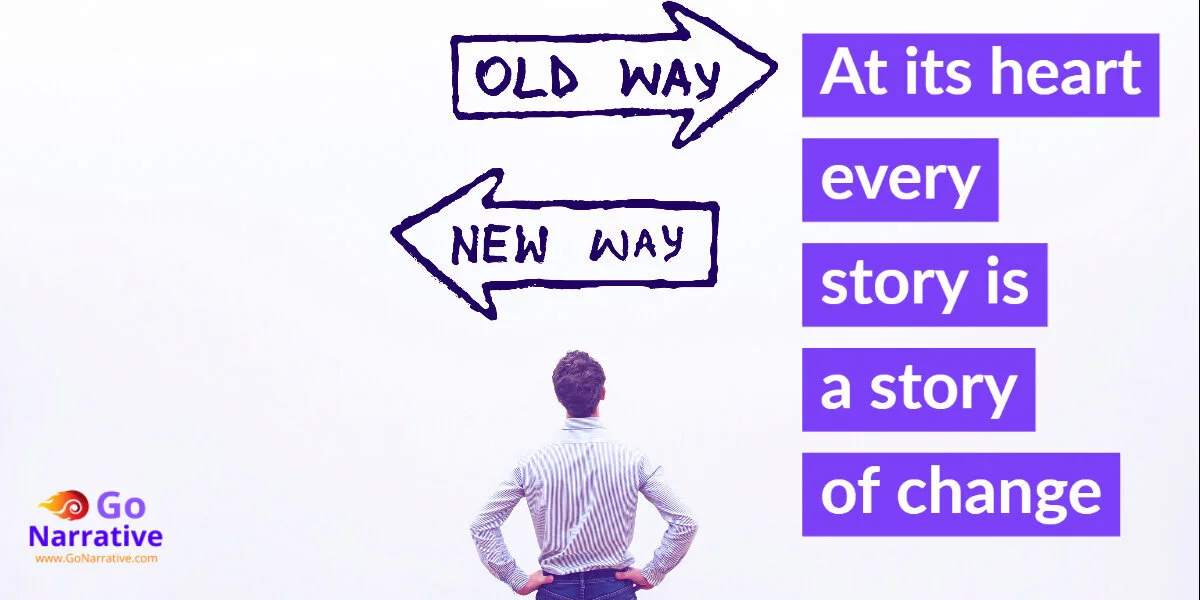
It seems pretty obvious when you break it down like this, but the better you are at articulating the before and after stages in your marketing materials, the quicker your customers will get the point, connect with what you're saying, and move on to the next stage of the journey.
Tying your product or service to a core emotional need
We know what you're thinking: "I can't just tell my customer, 'Here's what your life is now, and here's what it will look like after you work with us.'"
You're right. You can't do that – at least not so bluntly.
When you're telling stories at each stage of the customer journey, you need to tap into their emotions. Not just any emotion, mind you, but one or more of a few very specific core emotional needs that we all have as human beings.
You've probably heard of Maslow's Hierarchy of Needs. If you need a refresher, it's a five-tiered pyramid of basic human needs, starting with the most basic and important physiological needs (air, water, food, shelter, etc.), then moving up to safety, love and belonging, esteem, and finally, self-actualization.
Psychologists who have studied Maslow's work in-depth went one step further and identified nine core emotional needs that stem from the original hierarchy.
Safety: A safe environment to grow to our full potential
Volition: The power to exist autonomously and drive our own decisions
Attention: Giving and receiving attention, both to/from ourselves and the people we care about
Emotional connection: Feeling connected to others through love, friendship, and intimacy
Connection to the wider community: Feeling connected to something greater than ourselves
Privacy: Mental space to privately reflect on our experiences and learnings
Sense of self: Understanding our value within a group setting
Sense of achievement: The feeling that we are accomplishing something of value to society
Meaning: Our beliefs about life and our greater purpose as part of the wider universe
As a business leader or marketer, it's important to understand these emotional needs and connect the dots for your customers: What is it about your product or service that fulfills a core emotional need in their lives?

Now, there's won't always be a one-to-one correlation. Your solution may touch on multiple needs, and the specific need may change from stage to stage. The point is, you should be able to identify at least one need and use it as your "guiding star" for storytelling at each stage of the customer journey.
Let's consider Ashley, a project manager for a B2B firm. She's looking for new software to help her manage and communicate with her team more effectively. When we look at Ashley's journey through the lens of these Maslow-inspired emotional needs, it becomes clear that investing in a robust project management tool would tick off quite a few boxes for her:
Volition. Ashley wants to autonomously manage her projects in a way that makes her feel confident, and her team to feel empowered.
Attention. She wants her team and her supervisors to compliment her on her organization and leadership skills.
Sense of self. Ashley wants to be viewed by her colleagues and industry peers as an expert in project management, who knows how to leverage the latest, greatest tech solutions to optimize her team's workflow.
Sense of achievement. She wants to deliver on both the C-suite's expectations and the clients' expectations for the project in a timely and efficient manner. Ashley also wants her team to feel proud of their work and their role in the process.
If I were a marketer tasked with building content for landing pages, ad campaigns, blog, and social posts, videos, etc. targeting customers like Ashley, I would need to know all these things so I could tell stories that speak to Ashley's emotional motivations for needing a project management solution. With this knowledge, I can articulate the state change – the before and after – that Ashley hopes to achieve.
Early in Ashley's journey, I could tell broader stories about people who went from a place of feeling chaotic and out of control, to a place where they feel like they can lead their team successful. Later on, as she moves through the Awareness and Realization stages into the Internalize and Visualize stages, I can shift to more specific stories about people who went from a sub-optimal workflow to one that is streamlined, automated, and improved through a cloud-based project management solution. Finally, as she approaches the Decide stage, I can use a piece of content like a case study to show Ashley exactly how my product helped another brand complete projects quicker and feel more accomplished.
If you intentionally look at each stage and align your product with a potential buyer's emotional needs at that stage, you get the people who matter moving from stage to stage faster. And when you do this, you get them to be a customer faster.
You are the guide on your customer's journey
The greater lesson in all of this is the importance of understanding your customers, inside and out. It's why we at Go Narrative have developed all of these tools and frameworks – the 3Ds, the ARIVDE customer journey map, the Content Architecture model, and more – to support you, the marketer, in your most important role: The guide on the customer's journey.
We talk a lot about the fact that a brand's responsibility is to understand their customer, join them on their journey, and shape it for their betterment. Your brand is not the hero in your customer's story; your customer is the hero, and you're the guide.
When you deeply immerse yourself in your customer's journey, you can more easily and quickly guide them from stage to stage. You can show them the way forward because you've thought through and communicated their "before and after" states during each step. When you do, you will earn their trust and turn them into an evangelist for life.

Because we're all living our own stories, it's not surprising that storytelling makes sense as a solution to day-to-day business challenges like increasing sale pipe velocity. It's how our human brains retain information and internalize the most important lessons in our lives.
Our clients can attest to the fact that storytelling works. Even when they don't change anything about their campaigns except the content – they're still targeting the same people, and they're sticking with their original advertising, social, and PR budget. But when everything else stays the same and they take an outside-in, storytelling approach to their marketing, they see up to 40% improvement in their campaign take rates.
Therefore, we at Go Narrative know wholeheartedly that when you're looking to tackle your sales pipeline challenges, you're missing out when you fail to include storytelling.
Go Narrative is a Seattle Based marketing firm that assists business leaders in technology companies build and implement advanced marketing strategies. Our secret sauce is storytelling for business growth and transformation. We can help you cut through the noise and improve your reputation. We love helping business leaders understand, use and apply storytelling in business via writing, presentations, video, strategy and actionable plans. Get attention. Be heard. Sell more.
www.GoNarrative.com | eBook available at https://www.gonarrative.com/ebook1landingpage |
More about what we do, download the PDF.
If the story only works when you're in the room, that's a symptom.
Book a Narrative Diagnostic